Messenger
Mariners' Museum, Uncurated Search Results
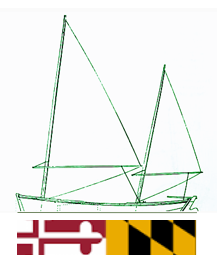
Type: Skipjack
Year: 1975
Builder:
Location:
These records are found in the online catalog of The Mariners’ Museum and Park in Newport News, Virginia. Uncurated search results are presented to give researchers and interested readers an idea of whether the museum’s archives contain information about this vessel and whether it may be worthwhile to visit the museum’s catalog search page for further investigation. Uncurated results may be inaccurate or incomplete.
Search mode: Exact Name. Search phrase(s): "Messenger". Results returned: 53. Results displayed in this table: 53.
Use these buttons to send uncurated search results to your own app or text document for further research. First, check the box for any row, or click "Select All" then uncheck any rows. Then click "Show Selections". You can then copy your selections from the text box and past them into your app.
| Fetch? | Row ID | Media | Date | Vessel | Place | Related Places | Inscription/Marks | Subject | Notes | Archive Number |
|---|---|---|---|---|---|---|---|---|---|---|
| 1 | 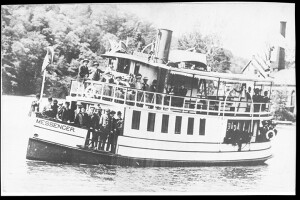 | 1885 | Messenger (Steamboat : 1885). | Hudson River "Messenger" 1885 | A side view of the Messenger while underway. | MS0091/03.01-35#057 | ||||
| 2 | 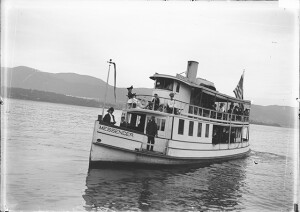 | 5/30/1905 | Messenger (Screw steamer : 1853). | Steamboats–United States.; Bodies of water.; Paddle steamers–United States.; Cities and towns–United States. | Shows the steamer Messenger under way. This is an identical negative to #89. | MS0095/02-#860 | ||||
| 3 | 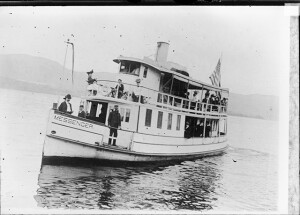 | Circa 1905 | Messenger (Screw steamer : 1853). | Steamboats–United States.; Bodies of water.; Paddle steamers–United States.; Cities and towns–United States. | Shows the steamer Messenger under way. This appears to be a photograph of a print made from negative 860. | MS0095/02-#89 | ||||
| 4 | 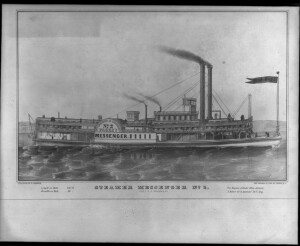 | 1883-1931 | Steamer Messenger No. 2; Pitsburgh & Cincinnati Packet. | Steamboats–United States. | Copy negative of an illustration of the steamer. | MS0091/03.02-02#1945 | ||||
| 5 | No image URL. | Messenger | P0001.011/01-2160 | |||||||
| 6 | No image URL. | Shipping–History. New Zealand | The Wellington Harbour Board's Maritime Museum has recently acquired two notebooks of Arthur Herbert Messenger which provide a record of shipping of both Wellington and Auckland. They are illustrated with drawings and watercolors. | LB57235 | ||||||
| 7 | No image URL. | United States–History, Naval. | Oceanography. | Detached from: Southern literary messenger. Mar. 1939. | LB40646 | |||||
| 8 | No image URL. | Naval messenger pigeon service. | LB78082 | |||||||
| 9 | No image URL. | Proposed naval messenger pigeon service. | LB78084 | |||||||
| 10 | No image URL. | Havre de Grace Maritime Museum–Periodicals. | Naval museums–Maryland–Havre de Grace–Periodicals.; Naval art and science–Periodicals. | Title from caption. Description based on: winter/spring 1993. | LB41557 | |||||
| 11 | 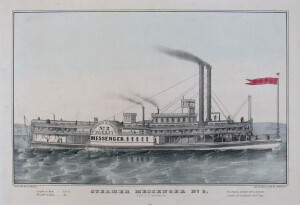 | VESSEL INFORMATION - VESSEL NAME: MESSENGER NO. 2 VESSEL BUILT: 1849 VESSEL TYPE: AMERICAN WOOD HULL SIDE WHEEL MISSISSIPPI STEAMBOAT BUILDER LOCAITON: FREEDOM, PENNSYLVANIA | CL19357 | |||||||
| 12 |  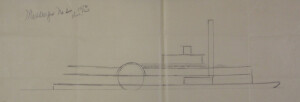 | INVENTORY: envelope - there is one (1) component part. | CL22893 | |||||||
| 13 | No image URL. | Messenger of Peace | P0001.011/01-2161 | |||||||
| 14 | No image URL. | Messenger pigeon service for naval purposes. | LB78080 | |||||||
| 15 | No image URL. | Literature | Southern literary messenger and the men who made it | LB104579 | ||||||
| 16 | 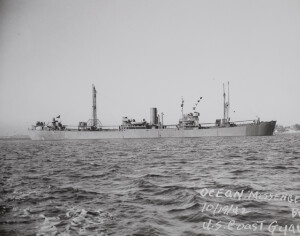 | Steamships | PUBLICATION RIGHTS: U.S. Coast Guard | P0001.003/01-#PB9196 | ||||||
| 17 | 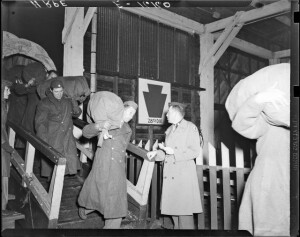 | 12/6/1945 | United States. Army–Leaves and furloughs. | Mr. T.M. Markler, ARC Asst Field Director waiting on apron of Pier 8, Newport News, HRPE, to give returning soldier emergency message to speed man home on an emergency furlough. Dec. 6, 1945. | World War, 1939-1945–War work–Red Cross.; Luggage–Virginia–Newport News. | Shows an ARC worker standing on a pier at the base of the gangplank as disembarking soldiers carrying their own luggage file past. | P0003/01-#E-16160 | |||
| 18 | No image URL. | Messenger pigeon service in connection with coast defense. | LB47937 | |||||||
| 19 | 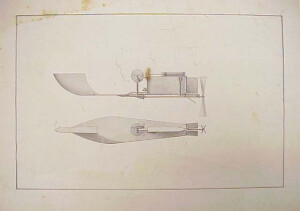 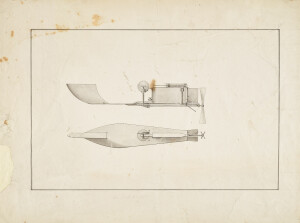 | SHORT DESCRIPTION: Ink and wash drawing of a cross section and elevation view of a one-man semi-submersible boat. The drawing shows the proposed method of propulsion, the propeller and rudder. NOTES: Wallace Hutcheon states on page 68 of 'Robert Fulton, Pioneer of Undersea Warfare': Robert Fulton's technical concept of the submarine had changed since the Brest operations of 1801. At some point during his first months in England, he made a drawing of a small submarine which he named the "Messenger." This submarine was to be nine feet long, thus large enough for one man only, but it was never constructed. NOTES: [From Sotheby’s catalog entry for lot 44 10/26/1983] Fulton's Nautilus was a "diving boat" equipped with a compressed air tank that allowed it to remain underwater for four and a half hours. Fulton constructed the vessel at LeHavre in the winter of 1800-1801, and he descended to a depth of twenty-five feet in the boat. The Nautilus's trials before French officials were so successful that Fulton was encouraged to proceed with his experiments and even took the Nautilus on coastal reconnoitering voyages against the British that summer. The Messenger is not known to have progressed beyond its planning stages: the boat was to be operated by a single man who guided the boat by foot-operated rudder and diving planes. [From Sotheby’s catalog entry 10/26/1983] Robert Fulton’s Designs for Naval and Submarine Warfare from the Solomon Alofsen Collection at the New Jersey Historical Society. The drawings offered here are the designs of Robert Fulton (1765-1815) for his experiments with submarine boats and naval armaments. While in France, Fulton built an operational submarine vessel, the Nautilus, which he tested personally in 1800 and 1801. At the same time, he began designs for submarine bombs and mines. In 1804, the British government persuaded the American artist-inventor to put his talents at the disposal of England, where he worked on naval weaponry for the next two years. There Fulton concentrated on larger craft that could remain at sea to launch his submarine bombs on enemy ships. He tested his designs in raids on Boulogne and demonstrated the effectiveness of mine warfare when he demolished the Dorothea in an experiment of 1805. When the British government refused the generous financial support that Fulton felt his experiments deserved, the inventor returned to the United States in the fall of 1806. Back in his native country, Fulton continued to dabble in improvements in his naval designs, even while he worked on the commercial success of his steamboat. His “torpedo” bombs were tested in New York harbor, and he published his famed pamphlet “Torpedo War and Submarine Explosions” in 1810. With government support, he continued his experiments, moving on to a “spar torpedos,” harpoon guns, and “anchored torpedos.” With the outbreak of the War of 1812, Fulton concentrated on his “submarine gun” or “Columbiad,” a precursor of modern torpedo techniques with guns that could fire underwater into the hull of an enemy craft. In 1814 Congress authorized him to construct the first steam war vessel, popular known as Fulton the First. Solomon Alofsen, a Dutch-born Jersey City engineer, was as associate of the inventor’s last years. In 1855 Alofsen presented to the Historical Society a collection of Fulton’s drawings and designs that he had inherited through this professional association. The selection of drawings from that collection offered here touches on almost every aspect of Fulton’s work in the fields of submarine and surface naval warfare. ADDITIONAL INFORMATION: See 'Robert Fulton, Pioneer of Undersea Warfare' by Wallace S. Hutcheon, Jr., Naval Institute Press, Annapolis, Maryland, 1981. | CL5904 | |||||||
| 20 | 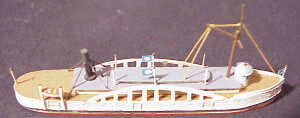 | NOTES: The accession 1995.34 includes 377 models built by Joseph Schmitt between 1970 and 1989. The models range in size from less than one inch to ten inches to less than one inch are a combination of scratch-built, kit-built and a combination of the two. The collection documents ships ranging from the mid-19th century up through vessels dating to the mid-1980s. It includes naval ships of the United States, Italy, Japan, Germany, Great Britain, Greece and France including carriers, destroyers, and naval auxiliaries. There are battleships of the Great White Fleet (including the never-built late Iowa and Montana classes) and even one Russian ice-breaker. There are Civil War monitors, container and cargo ships, passenger liners and cruise ships, combination vessels, excursion boats, Chesapeake Bay ferries, Great Lakes and Wester River passenger and freight boats and tugs. There's even a model of Pier 53, one of the famous Chelsea Piers on the North River in New York and a lighthouse. VESSEL INFORMATION- VESSEL NAME: MESSENGER ALL NAMES OF VESSEL: 1) MESSENGER NATIONALITY: AMERICAN HOME PORT: VESSEL TYPE: CARGO-PASSENGER STEAMSHIP OFFICIAL NUMBER: HULL NUMBER: VESSEL DIMENSIONS: 224 x 31; 444 TONS SERVICE DATES: 1866- SHIPBUILDER: SHIPBUILDER LOCATION: ENGINE BUILDER: ENGINE BUILDER LOCATION: SHIP OWNERS: SHIP LINE OR OPERATOR: N. ENGLEMAN CAPTAINS OR OTHER RELATED PEOPLE: MAJOR EVENTS: VESSEL HISTORY: DATE WRECKED: PLACE OF WRECKING: ASSOCIATED (RELATED?) PLACES: GREAT LAKES RELATED VESSELS: | CL24720 | |||||||
| 21 | 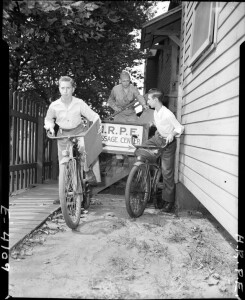 | 9/4/1943 | United States. Army–Postal service.; Port of Embarkation, Hampton Roads, Va. (U.S.). Message Center. | E4109 - Procedure of message delivery from HRPE message center. 9-4-43 Official photograph U.S.Army Signal Corps, HRPE, Newport News, Va. | Document delivery–Virginia–Newport News.; Bicycle messengers–Virginia–Newport News. | An officer handing a bicycle messenger a large envelope. Another bicycle messenger with an envelope is next to them. | P0003/01-#E-4109 | |||
| 22 | 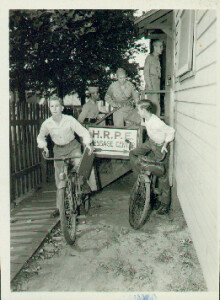 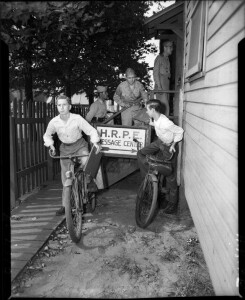 | 9/4/1943 | United States. Army–Postal service.; Port of Embarkation, Hampton Roads, Va. (U.S.). Message Center. | E4110 - Procedure of message delivery from HRPE message center. 9-4-43 Official photograph U.S.Army Signal Corps, HRPE, Newport News, Va. | Document delivery–Virginia–Newport News.; Bicycle messengers–Virginia–Newport News. | An officer handing a bicycle messenger a large envelope. Another bicycle messenger with an envelope is next to them. Two other men are entering the center in the background. | P0003/01-#E-4110 | |||
| 23 | 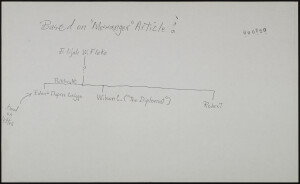 | Before 1992 | Genealogy. | Photocopy of notes showing familial connections between Elijah W. Flake and his grandchildren Edna (Mrs. Dupree) Griggs, a Wilson C., and a Robert. This family tree is based upon an article in a publication entitled "Messenger" about Elijah Flake, landsman on CSS Virginia. Title devised by Library staff. | MS0164.001/01-002.16#04 | |||||
| 24 | No image URL. | 4/16/1861 | United States. Navy–Records and correspondence.; Sabine (Frigate : 1858).; Wyandotte (Screw steamer : 1859). | United States–History–Civil War, 1861-1865–Personal narratives.; Fort Pickens (Fla.). | Two-page letter from John Worden to Leroy Pope Walker, Confederate Secretary of War. Worden gives a detailed account of his official visit as a messenger from the U.S. Secretary of the Navy in Washington to Captain Adams on board the USS Sabine in Pensacola. | MS0016/01-001.05#02 | ||||
| 25 | 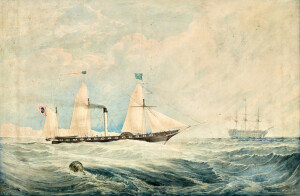 | SHORT DESCRIPTION: This watercolor features Peyk-i Şevket, a Turkish steam paddle ship. The artwork has been attributed to William John Huggins. The image shows the ship with smoke coming from the funnels. The ship has three flags: an Ottoman Naval flag at the stern, what might be a commissioning pennant on the mainmast and a blue and white striped flag on the foremast. There is mooring buoy in the foreground at the bottom left. In the background at the right there is a large Turkish ship-of-the-line (at least 80 guns?) which is also flying the flag of the Ottoman Navy and the blue and white striped flag on the mainmast. NOTES: The featured ship was identified by researcher Emir Yener on November 14, 2019 as Peyk-i Şevket. Built and launched in 1836 by French businessman Louis Benet in La Ciotat as the 330-ton paddle steamer Le Phocéen. It was reportedly the first steamship in the Mediterranean. Its first voyage was advertised as a pleasure cruise around the Mediterranean; visiting Marseilles, Algiers, Tunis, Malta, Navarino, Smyrna, Istanbul, Athens, Malta, Palermo before steaming back up the coast of Italy. In May 1836 American Fanny W. Hall of Vermont, traveled aboard Le Phocéen from Marseilles to Genoa to Livorno to Civitavecchia and described the ship’s luxurious accommodations: “This is the first trip of a new and superb steamboat, built expressly for the purpose of taking out parties of pleasure to the eastern coast of the Mediterranean. I have never seen a vessel finished in a style of such elegance; the ladies’ cabin is fitted up in a style of almost oriental luxury. A rich cut-glass lamp is suspended over the marble centre-table; we recline on voluptuous cushions, and ensconce ourselves at night behind curtains of the richest silk. The table is furnished with the finest porcelain from Sevres, each piece being marked with the coat of arms of ancient Massilia.” The ship sailed as Le Phocéen from April 1836 until February 1838 when the Ottoman Empire, under Sultan Mahmoud II, purchased the ship and renamed her Peyk-i Şevket, which means 'Messenger of His Majesty' or 'Messenger of Magnificence'. Peyk-i Şevket was used to transport goods and passengers between the ports of Istanbul and Izmir. Intending to regain control over a civil transport system that was dominated by foreign flagged vessels, the sultan ordered that transporting cargo and passengers on board foreign-flagged ships was prohibited unless a certain number of shipments were made using Peyk-i Şevket. VESSEL INFORMATION-- VESSEL NAME: PEYK-I SEVKET VESSEL TYPE: Paddle Steamship SERVICE DATES: 1838-? SHIP BUILDER: Louis Benet BUILDER LOCATION: La Ciotat, France BUILD DATE: 1836 SHIP OWNERS: France (1836-1838), Turkey (1838-?) VESSEL DIMENSIONS: 465 gross tons; 203' x 24' x 9' ALL SHIP NAMES: (1) LE PHOCEEN (1836-1838), (2) PEYK-I SEVKET (1838-?) | CL12811 | |||||||
| 26 | No image URL. | VESSEL INFORMATION -- VESSEL NAME: M/V COASTAL MESSENGER (1945-1952); USCGC COURIER (WAGR-410 1952-1964; WTR 410 1966-1972) BUILDER: FROEMING BROTHERS, INC. BUILDER LOCATION: MILWAUKEE, WISCONSIN BUILD DATE: 1945 VESSEL DIMENSIONS: 338.5 x 50.3 x 18, 5,800 tons standard, 7,50 full load VESSEL HISTORY: The Courier was a Maritime Administration C1-M-AV1 type cargo vessel originally launched as the M/V Coastal Messenger in 1945. Apparently she was to be originally named Doddridge but that was changed prior to her acceptance by the Maritime Administration. She was originally designed as an inter-island shuttle for military and naval cargoes. She was designed to receive cargo from much larger Victory and Liberty ships and then deliver it to U.S. forces on small outlying islands but was actually never used for that purpose due to the end of World War II. In the late-1940s she was operated by both the Standard Fruit Steamship Company and Grace Line, Inc., primarily along the coasts to northern South America. On a trip to South America she ran aground at La Salina on Lake Maracaibo, Venezuela but was freed after 11 days with extensive, though minor, damage. She was then apparently mothballed with the reserve fleet. The Coastal Messenger was transferred to the control of the Department of State in 1952. She was acquired to become a mobile transmitting facility for the U.S. Information Agency's "Voice of America" program in response to an initiative, code-named "Operation Vagabond," that was approved by President Harry Truman and the Joint Chiefs of Staff and announced by the Department of State in April, 1951. The operation was designed to provide a ship-borne radio relay station to transmit Voice of America programs behind the "Iron Curtain." Such a vessel could move to any areas of trouble quickly, could serve as a temporary relay station as needed, and permit the use of a station where it was impractical to build a shore station. To ease political sensitivities, it was decided that the Coast Guard should operate the vessels, which in the planning stages were to have been a total of six vessels. Excessive costs kept the operation to a single vessel. The head of the U.S. International Information Administration, Dr. Wilson Compton, noted at her commissioning that Courier was "designed to provide another electronic weapon for combating [sic] Soviet jamming and to enable the Voice of America to cover areas beyond the reach of present broadcasts." She was stationed in the waters of the eastern Mediterranean off the island of Rhodes, Greece, operating while anchored at undisclosed locations in those waters. While acting as a relay station, she also had a small studio and control center if program announcements or originations were needed. The Courier was "on the air" for 11 1/4 hours per day, seven days a week, and her broadcasts were made in 13 different languages. The Courier was ordered home in July of 1964 and she returned to the U.S. on 13 August 1964 after a record 12 years on station overseas. During that time she was "the only U.S. vessel in commission [at that time] that has been on duty outside the continental limits of the country for twelve consecutive years." She was then turned over to the Coast Guard Reserve Training Center at Yorktown, Virginia, and placed in "out of commission, in Reserve" status where she provided dockside training in merchant marine safety and dangerous cargo handling. She was recommissioned into the Coast Guard at Yorktown on 30 April 1966. Here her mission was to serve as a mobile operational training platform with qualified personnel attached and to aid by giving guidance during operational Port Security training at various sites during two week active duty for training periods. The Courier's area of operation covered the East Coast, the Gulf of Mexico, and the Great Lakes; her homeport was the Reserve Training Center in Yorktown. She carried accommodations for 220 trainees, patrol boats, and communication equipment. Her small boats were used to train reservists in harbor patrols while her cargo handling equipment was employed to train reservists in handling dangerous cargoes. | CL11710 | |||||||
| 27 | No image URL. | Fort Fisher (N.C. : Fort)–Siege, 1864-1865. | "This booklet is published from an address made by [the author] ... and was carried in the Wilmington Messenger on Thursday, June 15, 1893." | LB10441 | ||||||
| 28 | No image URL. | Virginia–History–Colonial period, ca. 1600-1775.; Virginia–History–Revolution, 1775-1783. | Enslaved persons–Virginia.; Point Pleasant, Battle of, W. Va., 1774. | Printer statement from t.p. verso. "Memoir of the battle of Point Pleasant, by Samuel L. Campbell": Appendix, p. [179]-200. | LB29251 | |||||
| 29 | 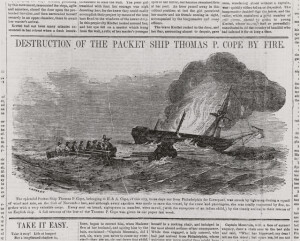 | on verso: packet ship Thomas P. Cope, Philadelphia; built 1845; owned by H&A Cope; burned Nov.26, 1846. Newspaper: Alexander's Messenger, Pa., Jan.6, 1847. | Copy photograph from a newspaper of the ship on fire with survivors in a rowboat. The image is titled "Destruction of the Packet Ship Thomas P. Cope by fire." | P0001.011/01-2940#PK6837 | ||||||
| 30 | 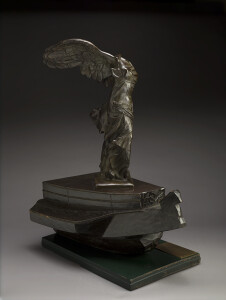 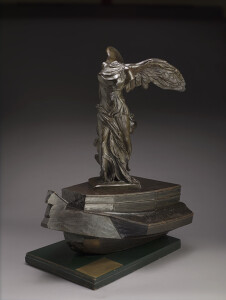 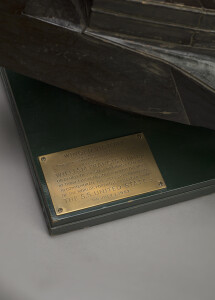 | SHORT DESCRIPTION: Sculpture of the Winged Victory of Samothrace. The sculpture is the work of Malvina Cornell Hoffman. No signature or date is visible. The small statue consists of a winged female figure – the messenger goddess Victory – and a base in the shape of the prow of a ship, standing on a low pedestal. The figure is wearing a long chiton, or tunic, that falls in folds to her feet. There are thick, deeply carved draped folds of a cloak or himation, which covers part of the chiton. The himation has worked loose at the figure’s left hip. The unfastened cloak is held against the Victory’s body by the sheer force of the wind. Unlike the original monument, the figure's left leg is not exposed but its shape is made visible by the drape of the fabric. The base of the statue depicts the prow of a battleship typical of the time. Hoffman has added a small ornament to the prow that is not depicted on the original monument. Hoffman has depicted oar boxes (structures jutting out from the ship’s flanks that on a ship would have been used to bear the weight of several tiers of longer, more powerful oars). NOTES: The statue was given to William Francis Gibbs by the employeers of Gibbs & Cox to commemorate the completion of the SS United States. LABEL COPY: Reproduction of Winged Victory of Samothrace, c. 1952 Attributed to Malvina Hoffman (American) 1887-1966 Predating the Christian angelic tradition by centuries, the winged goddess represented the triumph of mere mortals in the face of adversity. This reproduction of a Macedonian monument to naval supremacy was a fitting tribute to William Francis Gibbs upon the completion of SS United States. (A to Z, 2010) | CL21332 | |||||||
| 31 | 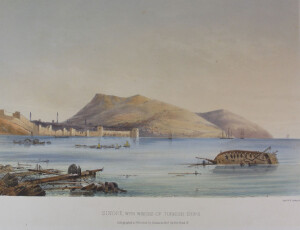 | NOTES: One of a series of eleven views (LP 4478-LP 4483) based on the sketches of Royal Navy Captain Hyde Parker (1825-1854) published in 'A Series of Sketches in the Black Sea' lithographed and published by Dickinson Bros. 114 New Bond Street, London, circa 1853. Parker commanded the steam warship HMS Firebrand (a 2nd class paddle frigate or sloop) in the Black Sea. He took command of the ship on the December 18, 1852 and was tasked with compiling a survey of the Crimea Peninsula and the adjacent coastlines. Besides landscapes he also captured local people. Parker was killed on July 8, 1854, shortly after this work was published, when storming a Russian fort at the Sulina Mouth of the Danube River. He was the 4th in an unbroken line of 'Hyde Parkers' to serve in senior roles in the Royal Navy. His great-grandfather Admiral Sir Hyde Parker, 5th Baronet (1714-1783), was Commander of the West Indies Station, his grandfather Admiral Sir Hyde Parker (1739-1807) was Horatio Nelson's commander at Copenhangen in 1801, and his father Admiral Sir Hyde Parker (1784–1854) served as First Lord of the Admiralty (1853-4). 'A Series of Sketches in the Black Sea' was a lavish and luxurious production likely made as a fine art piece and/or as a grand memorial to Captain Parker, as opposed to being a commercial production. Dickinson Brothers of 114 New Bond Street, London, was known for top-end custom fine art projects, and not mass production. Its issue was likely sponsored by wealthy patrons, and only a small number of sets were ever made, as they were intended for circulation amongst a select audience. The plates comprise: a composite of local types, ‘Village of Beicos – Bosphorus’; ‘Batoum – Frontier of Georgia’ [LP 4481]; ‘Greek Encampment – Besika Bay’; ‘Trebizond’ [panorama] [LP 4482]; ‘Beicos Bay, Bosphorus’ [LP 4478]; ‘Sinope, with wrecks of Turkish Ships’ [LP 4479]; ‘Bashi-Bazouk’, ‘Military Pasha & Attendant’ & ‘Tatar (Government Messenger)’; ‘Sinope, From the Peninsula’ [LP 4480]; ‘Panoramic View of the Southern Coast of the Crimea’ [panorama] [LP 4483]. | CL20426 | |||||||
| 32 | No image URL. | Red Sea–Description and travel.; Mediterranean Sea–Description and travel.; Saudi Arabia–Description and travel.; Ethiopia–Description and travel. | Works issued by the Hakluyt Society. 2nd ser. ; no. 100 | Voyages and travels. | Includes reprints of: Pitts' account of his journey from Algiers to Mecca and Medina and back (an extract from his A true and faithful account of the religion and manners of the Mohammetans, 3d ed., 1731): Daniel's A journal or account of William Daniel his late expedition to go from London to Surrat, London, 1702; and Poncet's A voyage to Æthiopia made in the year 1698, 1699, and 1700, London, 1709. With reproductions of the title pages of Daniel's and Poncet's works. | LB96660 | ||||
| 33 | 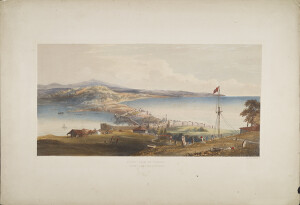 | NOTES: One of a series of eleven views (LP 4478-LP 4483) based on the sketches of Royal Navy Captain Hyde Parker (1825-1854) published in 'A Series of Sketches in the Black Sea' lithographed and published by Dickinson Bros. 114 New Bond Street, London, circa 1853. Parker commanded the steam warship HMS Firebrand (a 2nd class paddle frigate or sloop) in the Black Sea. He took command of the ship on the December 18, 1852 and was tasked with compiling a survey of the Crimea Peninsula and the adjacent coastlines. Besides landscapes he also captured local people. Parker was killed on July 8, 1854, shortly after this work was published, when storming a Russian fort at the Sulina Mouth of the Danube River. He was the 4th in an unbroken line of 'Hyde Parkers' to serve in senior roles in the Royal Navy. His great-grandfather Admiral Sir Hyde Parker, 5th Baronet (1714-1783), was Commander of the West Indies Station, his grandfather Admiral Sir Hyde Parker (1739-1807) was Horatio Nelson's commander at Copenhangen in 1801, and his father Admiral Sir Hyde Parker (1784–1854) served as First Lord of the Admiralty (1853-4). 'A Series of Sketches in the Black Sea' was a lavish and luxurious production likely made as a fine art piece and/or as a grand memorial to Captain Parker, as opposed to being a commercial production. Dickinson Brothers of 114 New Bond Street, London, was known for top-end custom fine art projects, and not mass production. Its issue was likely sponsored by wealthy patrons, and only a small number of sets were ever made, as they were intended for circulation amongst a select audience. The plates comprise: a composite of local types, ‘Village of Beicos – Bosphorus’; ‘Batoum – Frontier of Georgia’ [LP 4481]; ‘Greek Encampment – Besika Bay’; ‘Trebizond’ [panorama] [LP 4482]; ‘Beicos Bay, Bosphorus’ [LP 4478]; ‘Sinope, with wrecks of Turkish Ships’ [LP 4479]; ‘Bashi-Bazouk’, ‘Military Pasha & Attendant’ & ‘Tatar (Government Messenger)’; ‘Sinope, From the Peninsula’ [LP 4480]; ‘Panoramic View of the Southern Coast of the Crimea’ [panorama] [LP 4483]. | CL20427 | |||||||
| 34 | 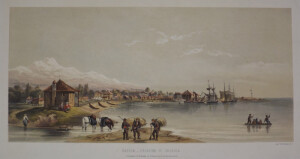 | NOTES: View of a bay sweeping in from the right, with a town of small houses along the sea-front, canoes drawn up on shore, sails near the point in the middle distance and several figures, with three men holding guns in the foreground, two carrying sheaves on their backs. NOTES: One of a series of eleven views (LP 4478-LP 4483) based on the sketches of Royal Navy Captain Hyde Parker (1825-1854) published in 'A Series of Sketches in the Black Sea' lithographed and published by Dickinson Bros. 114 New Bond Street, London, circa 1853. Parker commanded the steam warship HMS Firebrand (a 2nd class paddle frigate or sloop) in the Black Sea. He took command of the ship on the December 18, 1852 and was tasked with compiling a survey of the Crimea Peninsula and the adjacent coastlines. Besides landscapes he also captured local people. Parker was killed on July 8, 1854, shortly after this work was published, when storming a Russian fort at the Sulina Mouth of the Danube River. He was the 4th in an unbroken line of 'Hyde Parkers' to serve in senior roles in the Royal Navy. His great-grandfather Admiral Sir Hyde Parker, 5th Baronet (1714-1783), was Commander of the West Indies Station, his grandfather Admiral Sir Hyde Parker (1739-1807) was Horatio Nelson's commander at Copenhangen in 1801, and his father Admiral Sir Hyde Parker (1784–1854) served as First Lord of the Admiralty (1853-4). 'A Series of Sketches in the Black Sea' was a lavish and luxurious production likely made as a fine art piece and/or as a grand memorial to Captain Parker, as opposed to being a commercial production. Dickinson Brothers of 114 New Bond Street, London, was known for top-end custom fine art projects, and not mass production. Its issue was likely sponsored by wealthy patrons, and only a small number of sets were ever made, as they were intended for circulation amongst a select audience. The plates comprise: a composite of local types, ‘Village of Beicos – Bosphorus’; ‘Batoum – Frontier of Georgia’ [LP 4481]; ‘Greek Encampment – Besika Bay’; ‘Trebizond’ [panorama] [LP 4482]; ‘Beicos Bay, Bosphorus’ [LP 4478]; ‘Sinope, with wrecks of Turkish Ships’ [LP 4479]; ‘Bashi-Bazouk’, ‘Military Pasha & Attendant’ & ‘Tatar (Government Messenger)’; ‘Sinope, From the Peninsula’ [LP 4480]; ‘Panoramic View of the Southern Coast of the Crimea’ [panorama] [LP 4483]. | CL20428 | |||||||
| 35 |  | NOTES: This panorama shows the appearance of the coast of Crimea at the time of the Crimean War. The image shows a stretch of the coastline shown from Mys Mehanom (Cape Meganom) to Mys Kiik-Atlama (KaitLama), Mys Khameleon (Koktebel), to Feodosia is in the vicinity of the City of Kaffa. This was the ancient city (Greek) of Theodosia, an important port in its day. It played little part in the Crimean War, although fighting took place at Kertch, about 60 miles to the west. A Gazaetteer of the time says "The climate of the N.W. portion (of the Crimea) is cold and humid in winter and hot and dry in summer; but the S.E. part, defended by the mountains from the north winds, is mild and salubrious. NOTES: One of a series of eleven views (LP 4478-LP 4483) based on the sketches of Royal Navy Captain Hyde Parker (1825-1854) published in 'A Series of Sketches in the Black Sea' lithographed and published by Dickinson Bros. 114 New Bond Street, London, circa 1853. Parker commanded the steam warship HMS Firebrand (a 2nd class paddle frigate or sloop) in the Black Sea. He took command of the ship on the December 18, 1852 and was tasked with compiling a survey of the Crimea Peninsula and the adjacent coastlines. Besides landscapes he also captured local people. Parker was killed on July 8, 1854, shortly after this work was published, when storming a Russian fort at the Sulina Mouth of the Danube River. He was the 4th in an unbroken line of 'Hyde Parkers' to serve in senior roles in the Royal Navy. His great-grandfather Admiral Sir Hyde Parker, 5th Baronet (1714-1783), was Commander of the West Indies Station, his grandfather Admiral Sir Hyde Parker (1739-1807) was Horatio Nelson's commander at Copenhangen in 1801, and his father Admiral Sir Hyde Parker (1784–1854) served as First Lord of the Admiralty (1853-4). 'A Series of Sketches in the Black Sea' was a lavish and luxurious production likely made as a fine art piece and/or as a grand memorial to Captain Parker, as opposed to being a commercial production. Dickinson Brothers of 114 New Bond Street, London, was known for top-end custom fine art projects, and not mass production. Its issue was likely sponsored by wealthy patrons, and only a small number of sets were ever made, as they were intended for circulation amongst a select audience. The plates comprise: a composite of local types, ‘Village of Beicos – Bosphorus’; ‘Batoum – Frontier of Georgia’ [LP 4481]; ‘Greek Encampment – Besika Bay’; ‘Trebizond’ [panorama] [LP 4482]; ‘Beicos Bay, Bosphorus’ [LP 4478]; ‘Sinope, with wrecks of Turkish Ships’ [LP 4479]; ‘Bashi-Bazouk’, ‘Military Pasha & Attendant’ & ‘Tatar (Government Messenger)’; ‘Sinope, From the Peninsula’ [LP 4480]; ‘Panoramic View of the Southern Coast of the Crimea’ [panorama] [LP 4483]. | CL20430 | |||||||
| 36 | 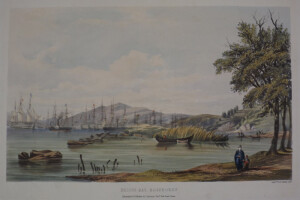 | NOTES: British and French Fleets in Belicos Bay: Russia and Turkey, being already at war in October 1853, there was danger of a Russian attack on Constantinople. The arrival of the British and French fleets and their presence in Belicos Bay, near Constantinople, effectively took care of the danger of Russian attack, even though the allies were not then involved in the war. Ref: The Royal Navy - Clowes NOTES: One of a series of eleven views (LP 4478-LP 4483) based on the sketches of Royal Navy Captain Hyde Parker (1825-1854) published in 'A Series of Sketches in the Black Sea' lithographed and published by Dickinson Bros. 114 New Bond Street, London, circa 1853. Parker commanded the steam warship HMS Firebrand (a 2nd class paddle frigate or sloop) in the Black Sea. He took command of the ship on the December 18, 1852 and was tasked with compiling a survey of the Crimea Peninsula and the adjacent coastlines. Besides landscapes he also captured local people. Parker was killed on July 8, 1854, shortly after this work was published, when storming a Russian fort at the Sulina Mouth of the Danube River. He was the 4th in an unbroken line of 'Hyde Parkers' to serve in senior roles in the Royal Navy. His great-grandfather Admiral Sir Hyde Parker, 5th Baronet (1714-1783), was Commander of the West Indies Station, his grandfather Admiral Sir Hyde Parker (1739-1807) was Horatio Nelson's commander at Copenhangen in 1801, and his father Admiral Sir Hyde Parker (1784–1854) served as First Lord of the Admiralty (1853-4). 'A Series of Sketches in the Black Sea' was a lavish and luxurious production likely made as a fine art piece and/or as a grand memorial to Captain Parker, as opposed to being a commercial production. Dickinson Brothers of 114 New Bond Street, London, was known for top-end custom fine art projects, and not mass production. Its issue was likely sponsored by wealthy patrons, and only a small number of sets were ever made, as they were intended for circulation amongst a select audience. The plates comprise: a composite of local types, ‘Village of Beicos – Bosphorus’; ‘Batoum – Frontier of Georgia’ [LP 4481]; ‘Greek Encampment – Besika Bay’; ‘Trebizond’ [panorama] [LP 4482]; ‘Beicos Bay, Bosphorus’ [LP 4478]; ‘Sinope, with wrecks of Turkish Ships’ [LP 4479]; ‘Bashi-Bazouk’, ‘Military Pasha & Attendant’ & ‘Tatar (Government Messenger)’; ‘Sinope, From the Peninsula’ [LP 4480]; ‘Panoramic View of the Southern Coast of the Crimea’ [panorama] [LP 4483]. | CL20425 | |||||||
| 37 | No image URL. | "Fleet's in!" - by express : __transportation of priceless ship model collection to U.S. Naval Academy is extraordinary feat. | LB108800 | |||||||
| 38 | 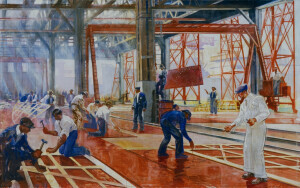 | SHORT DESCRIPTION: Oil on canvas by Thomas C. Skinner "The Laying Off Shop" at NNSB&DDCo. NOTES: (Benn Trask, Associate Curator 1/13/1999) On July 23, 1998 and again today, I had the opportunity to talk with Edgar L. Nettles (b. 1912) about the large mural scene on the Newport News Shipyard titled "The Laying Off Shop" (42.456) by Thomas C. Skinner hanging in the Great Hall of Steam. Edgar remarked that the painting was "perfect" and it shows every facet that was going on that morning. Edgar remembers Skinner making the sketches. In the lower left hand side of the painting are: Lou Parham; Sam Buxton (college student working summers, later became an attorney); Edgar L. Nettles (ship fitter); and his father Elritt N. Nettles (first-class mechanic whose specialty was shell plates for the hull). The steel has red primer, and as Edgar remembers it came mostly by barge from Bethlehem Steel, Sparrow's Point, Maryland. The ship in the right background was in for repairs. The metal was for the USS YORKTOWN and/or USS ENTERPRISE. The crane operator working outside would lay the steel out from the flat cars and Edgar would flip the molds. When they worked outside it could be 90 to 95 degrees. Edgar would mark holes with a tit punch and ball peen hammer then another worker would bore the holes. Edgar was taught by watching his father work, then after work he would spend extra time teaching Edgar the trade. Edgar's father stressed attention to detail and speaking of his father, Edgar remembered "anything he turned out he did right." His father learned the trade from a Scotchman." Edgar has volunteered for the museum for more than twenty years. He was born in Newport News and graduated from Newport News High School. Starting in 1928, he was first an office boy and later a messenger/rider on a bicycle in the superintendent's office. The first summer he worked at the shipyard the light cruisers HOUSTON and AUGUSTA were under construction. He told me that first year he did as much playing as working, especially around those cruisers. Later, for a brief period, he worked at the Daily Press before returning to the yard where he spent the remainder of his career first as a fitter and later in another department. View of workup using wooden templates to mark steel plate for cutting, drilling, etc. Shipyard security guard visible at center. | CL10472 | |||||||
| 39 | No image URL. | SHORT DESCRIPTION: Black and white book illustration titled 'View of the Hudson From the Vicinity of West Point.' Engraved by Littell and published by DeWolfe, Fiske & Company in Boston. The image shows a view looking down the Hudson at sunset. Many sailing boats and a steamboat, possibly the Garrison ferry, are on the river. The river is bordered by steep highlands. In the foreground a man and two women stand on a plain with their backs to the viewer. A stone bridge or walkway is visible at the lower left corner. At the left center there are some buildings on an open plain near the water, but the main structures of the school are not visible. NOTES: The image is page 13 of 'America Illustrated' (1883 edition). The first edition of this work was published in 1874, printed by The Arundel Print in New York and copyrighted by John D. Williams, the editor. In 1877 the publisher is identified as J. David Williams, at 38 New Street in New York. In 1879 the publisher is The New York Printing & Publishing Company. In 1883 the book was published by DeWolfe, Fiske & Company in Boston. Another 1883 edition was published by the Manhattan Printing and Publishing Company, New York. It also matches 'View from West Point (Hudson River)'. Artist/engraver/cartographer: W.H. Bartlett. Provenance: "American Scenery, or land, lake, and river illustrations of a transatlantic nature", from drawings by W.H. Bartlett, by N.P. Willis, Esq; George Virtue & Co, London, 1837. NOTES: The accompanying text on pages 12 and 14 reads: THE HUDSON RIVER AT WEST POINT. SINCE the time when Hendrick Hudson first sailed up the broad stream that bears his name, it has been a river of romance. The graceful prose of Irving has bestowed fame upon the Headless Horseman and the sleepy good-for-naught Rip Van Winkle, and many poetic recollections cluster about the quiet waters and picturesque banks. The river flows through landscapes of varied beauty, and on either side, as far as the eye can reach, the dark outlines of the Kaatskills and Highlands loom up. The bosom of the stream is dotted with the white sails of yachts and pleasure-boats, and its silence is often broken by the steady paddle-stroke of the stately steamboats that ply between the towns and cities on its shores. Our artist has taken as his subject for illustration the most beautiful and historically the most interesting portion of the river--West Point in the Highlands . The history of the spot on which the famous military academy stands is very romantic. Its natural strength made it a valuable site for a fortress, and the Continental Congress ordered the erection of Fort Putnam at a point 598 feet above the level of the river, commanding a view of the surrounding country for many miles. An approach from the Hadson was made well nigh impossible by an almost perpendicular wall of rock, while on the western and south-western side the steep hills formed a strong barrier. A small force could fold the position for a long tone against an enemy much superior. Above the fort, on a higher plateau, Fort Clinton and the other fortifications were built, forming altogether one of the most formidable strongholds in the world. That this important point came near being treacherously surrendered to the British in 1780, is a familiar fact to readers of American history. It was in command of Benedict Arnold, a man whose dissipation had plunged him deeply into debt, and who was ready to betray his trust for the double purpose of replenishing his purse and gratifying his private revenge. It is well known how nearly he succeeded, and how finally he failed. Major André, whom he was to meet to perfect the arrangements for the delivery of the fortress, was captured by three American soldiers, and the plot was discovered . Washington was to have made a visit of inspection to Fort Putnam and the other redoubts on this side the river, only two or three hours before his discovery of the treason of Arnold, at that moment as he supposed in command at West Point. The commander-in-chief was expected to arrive the evening before, and had he done so, Arnold would probably never have escaped. Having accidentally met the French minister, M. de Lucerne, at Fishkill, however (eight miles above), he was induced to pass the night there for the purpose of some conference, and set off early in the morning on horseback, sending on a messenger to Mrs. Arnold that himself and suite would be with her to breakfast. Arriving opposite West Point, near a small redoubt called Fort Constitution, Washington turned his horse from the road. Lafayette, who was then in his suite, called out, General, you are going in the wrong direction, you know Mrs. Arnold is waiting breakfast for us." "Ah," answered Washington, "I know you young men are all in love with Mrs. Arnold, and wish to get where she is as soon as possible. Go and take your breakfast with her, and tell her not to wait for me: I must ride down and examine the redoubts on this side the river." Two of the aides rode on, found breakfast waiting, and sat down at once with General Arnold and his family. While they were at table, a messenger came in with a letter for Arnold, which announced the capture of André, and the failure and betrayal, of course, of the whole conspiracy. Showing little or no emotion, though his life hung upon a thread, he merely said to one of his aides that his presence was required at West Point; and, leaving word for General Washington that he was called over the river, but would return immediately, he ordered a horse and sent for Mrs. Arnold to her chamber. He then informed her abruptly that they must part, possibly forever, and that his life depended on his reaching the enemy's lines without delay. Struck with horror at this intelligence, she swooned and fell senseless. In that state he left her, hurried down stairs, mounted a horse belonging to one of his aides that stood saddled at the door, and rode with all speed to the bank of the river. A boat with six men was in waiting; and, pretending that he was going with a flag of truce, he pulled down the stream, and arrived safe on board the Vulture sloop-of-war, lying some miles below. André was carried to headquarters, and, after a military trial, was executed, notwithstanding the strenuous efforts of the British authorities to save him. Arnold served for a while in the enemy's army. At the close of the war he went to Europe, where he died in obscurity, shunned by those to whom he had so basely sold his honor. The national military academy was established by Act of Congress in 1802. It is supported by the Government, and the cadets are under no expense for tuition or maintenance; but they are required to serve in the regular army for a term of years after graduation. The appointments are made by Congressmen, and the candidates for admission must be between the ages of sixteen and twenty-one. The course of study, which is full and thorough in all that relates to a military education, requires five years for completion. The academy buildings are erected on a plain nearly two hundred feet above the Hudson, and cover an area a mile in circuit. In addition, there is ample space for the practice of gunnery, and the necessary military evolutions. The impression that cadets studied at West Point as a stepping-stone to some other profession seems to have obtained credence abroad. How erroneous was this opinion may be seen from the remarks of a distinguished European critic who has recently enquired into the subject, and who says: "The point which above all others must strike an observer is the extremely stern military spirit which pervades the whole discipline and teaching. The course is not only longer than at European colleges maintained for similar objects, but is probably more strict and exacting than that of any on the other side of the Atlantic." For many years West Point was considered a useless expense by the people, and newly elected Representatives were wont to make the system of educating what they called "military snobs," the subject of their maiden speeches in the House; but the war with Mexico, and especially the war of the Rebellion, gave ample testimony of its value. Gens. Scott, Grant, Sherman, Sheridan, Mitchell, and many other prominent Union generals graduated there, and the rebel leaders Lee, Pemberton, Stonewall Jackson, and Johnson, also received from the National Government the military knowledge that enabled them to conduct their armies so well. | CL17193 | |||||||
| 40 | No image URL. | NOTES: Silver plated cruet stand with six cut glass bottles and engraved VERMONT. VESSEL INFORMATION: VESSEL NAME: VERMONT VESSEL TYPE: SIDE-WHEEL STEAMBOAT VESSEL DIMENSIONS: 261'4" (length) x 36' (breadth); VESSEL BUILT: 1871 SERVICE DATES: 1871-1903 BUILDER LOCATION: SHELBURNE, VERMONT OWNER: Champlain Transportation Company VESSEL HISTORY: Vessel used on Lake Champlain. Converted into a barge in 1903. --The Burlington Free Press, March 14, 1871, page 3: The new steamer "Vermont," which has been building for a year a that shipyard of the company near Burlington (Champlain Transportation Company), is receiving the finishing touches and will be ready to take her place in the line with the opening of the pleasure travel in June. She is 180 feet long and of proportionate width and is of about 1300 tons burthen. Being a little longer than the Adirondack, her companion boat, she is the largest vessel on the lake. She will have excellent state-room accomodations for two hundred and fifty passengers. In general style and finish she resembles the Adirondack, but is more costly and elegant than the beautiful steamer. The finishing woods are black walnut and chestnut, used in relief, and the richness of the interior can be described only to those who have paced the spacious saloons of the Adirondack. The old officers of the latter, Captain Willian H. flagg and clerk J. N. Hills, have been appointed to the Vermont...the engines in Vermont were transferred from the steamer Canada. --The Enterprise and Vermonter, September 29, 1871, page 1: [Excerpt of larger article] Compare a few facts relating to the second Vermont, launched in Shelburne Bay, September 1870, maker her first trial trip from the wharf at Burlington, June 25, 1871, and commencing her regular trips June 30. She is 275 feet in length, 36 feet beam, and 60 feet in width over the guards; engine of 400 horse-power; cylinder, 56 inches; stroke, 12 feet; wheels, 34 feet diameter and 9 feet 4 inches face, and will make twenty-three revolutions in a minute; tonnage 1,409. Cost, $200,000. Her dining cabin will seat one hundred and fifty persons. She has a grand state-room hall extending in an unbroken sweep 175 feet and 19 feet wide; sixty-one state-rooms, besides reading rooms, president's room, family room, bridal room, etc. She is gorgeous with Brussels and Axminster carpets, luxurious with sofas of the richest material, trimmed with walnut, chestnut, marble and gilt. Ten men could manage the first Vermont. The second Vermont's officers and crew number sixty. On her trial trip she ran twenty-five miles in seventy-three minutes. The Vermont of 1871 carries over two hundred and thirty passengers daily, and she is but one of three daily line boats on the lake. Colonel Cannon, President of the Champlain Transportation Company, is the prime mover in originating and building the Vermont, of which he may be justly be proud, while Captain William H. Flagg, a dignified man of princely demeanor, walks the deck of this "thing of beauty" with the heart of a gentleman and the step of a lord. --Considering an article published in the St. Albans Daily Messenger, January 27, 1902, page 8, it appears the Champlain Transportation Company was building a new steamer named Vermont. The Burlington Free Press of September 4, 1902, page 2 carries an article of the new Vermont's launch. INVENTORY: Six (6) glass cruet glass bottles and one (1) stand. There are seven (7) component parts. | CL1188 | |||||||
| 41 | 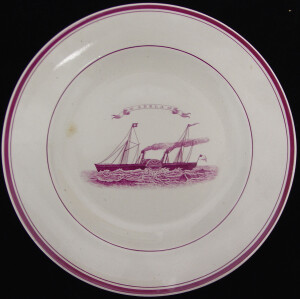 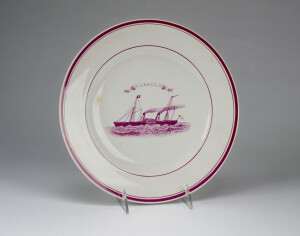 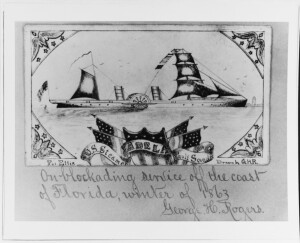 | SHORT DESCRIPTION: Ceramic plate with a center view of the port side of the twin stacked paddle steamer ADELA with title above print. Rim of plate decorated with two maroon stripes. Marked on the reverse with two crossed scroll-like lines (the mark for Thomas Minton of Stoke) over the letters BB, for Best Body, the words NEW STONE on reverse. There is a painted cypher on the reverse side of the plate but it doesn't match Minton's cyphers for the 1859-1862 time period (closest is 1857). The ship is flying a British white ensign (this flag would not normally be flown on a merchant vessel and may have been done purely to keep the design just one color) at the stern so obviously depicts the vessel before it was taken over by the US Navy in 1862-1863. NOTES: According to William Chaffers in "Marks and Monograms on European and Oriental Pottery and Porcelain..." all earthenware made by Minton was stamped "B.B. New Stone" between 1845 and 1861. NOTES: The ship on this plate was original identified as the 1877 steamer named Adela, but that vessel was a single funnel ship. The Adela on the china plate has two funnels which makes it the vessel built for the Androssan-Belfast passenger Service. VESSEL HISTORY: [Notes from Clydebank Ships and British Blockade Runners in the American Civil War by Joseph McKenna] Adela was built in 1859 by James & George Thomson, Govan at the Cessnock Bank yard. The ship was completed in August 1859. She was a brig-rigged iron paddle steamer. The first owner was the Ardrossan Steam Navigation Company for the passenger service between Ardrossan and Belfast. The service did not prosper and in March 1862 the vessel was chartered as a blockade runner. The Adela arrived at Bermuda on June 19, 1862. She refueled with coal, apparently took on a cargo and the attempted to run into Wilmington. Forewarned by Consul Charles Allen, the USS Quaker City and Huntsville lay in wait. On July 7, 1862, having just left port, but allegedly still within the marine league, she was fired upon by the federal cruisers. Of six shots, two struck her. The captain, James Walker, gave up the ship and she was taken to Key West for adjudication. Her arrest proved to be a cause celebre, as she was carrying Royal Mail, and was captured in British waters. The mail was returned unopened, but the Adela was condemned. She was later acquired by the US Navy for the blockade service. Newspaper article, Liverpool Mercury, August 7, 1862: The American Blockade-On the 7th of July, when the Quaker City (Federal steamer) was to the northward and eastward of Abaco, a sail was reported visible close under the land, which proved to be a steamer, the Adela, previously reported captured, Captain Walker, formerly of the Great Eastern. The Adela hoisted English colours; the Quaker City did not respond until they got into neutral water (?), when she hoisted the stars and stripes, and sent a messenger in the shape of a 20-pounder Parrott shell as a request for the Englishman to heave to, which was unheeded, as the shot did not touch her. A second, third, and fourth were tried with a like result. All this time the two vessels were steaming ahead, the Adela having the advantage in speed, the distance between them being about three miles. At last the fifth shot was fired, which passed over the Adela’s taffrail, striking the quarterdeck, tearing up several planks, cutting off an iron deck beam, passing into the captain’s room, which it tore to pieces, and then through an iron bulkhead, which it thought, no doubt, it had gone far enough, and stopped, and with it the vessel, for she hove to until the Quaker City came up and took possession of her. She was sent to Key West under charge. | CL5081 | |||||||
| 42 | 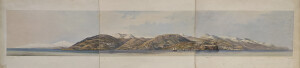 | SHORT DESCRIPTION: Panorama print in three parts of the Coastline around Trabzon, Turkey, from Captain Hyde Parker's "A Series of Sketches in the Black Sea," lithographed and published by Dickinson Bros. 114 New Bond Street, London, circa 1853. Panorama of the Black Sea coastline with snow-capped mountains in the distance, with the port city of Trabzon (Trebizond) in the center, at the foot of verdant slopes. The harbor of Trabzon is dominated by a fort atop a promontory, while several minarets add definition to the city which unfolds in the background. Lettered below the image is the title, while a key, viewed left to right reads: 'Cape Fidgi / Khonsi point / Kalmek Point / Platana / Cape Jones'. It was the largest of the 11 views included in the very rare set A Series of Sketches in the Black Sea. NOTES: Trabzon, while then having a population of barely 20,000, was nevertheless a place of considerable importance. Located on the southeastern end of the Black Sea, it was since ancient times the principal trading gateway between Europe and Persia. It was the capital of the Greek Empire of Trebizon, from 1204 to 1461, and since the Ottoman conquest had been the center of the Eyelat of Trabzon. Both the celebrated prelate and scholar Basilios Bessarion (1403-72) and the greatest of all Ottoman rulers, Suleiman the Magnificent (1494-1566), were born in the city. During the Crimean War (1853-55), which pitted an alliance of Britain, France and the Ottoman Empire against Russia, Trabzon served as an important naval base. Up to this point, the Black Sea had been largely off-limits to British mariners, and the immense beauty and diverse and sophisticated cultures of the region fascinated British aritists and writers. As the war continually brought the Black Sea to the top of the news, Britons were eager to consume any material that would give them a better understanding of this hitherto mysterious part of the World. NOTES: One of a series of eleven views (LP 4478-LP 4483) based on the sketches of Royal Navy Captain Hyde Parker (1825-1854) published in 'A Series of Sketches in the Black Sea' lithographed and published by Dickinson Bros. 114 New Bond Street, London, circa 1853. Parker commanded the steam warship HMS Firebrand (a 2nd class paddle frigate or sloop) in the Black Sea. He took command of the ship on the December 18, 1852 and was tasked with compiling a survey of the Crimea Peninsula and the adjacent coastlines. Besides landscapes he also captured local people. Parker was killed on July 8, 1854, shortly after this work was published, when storming a Russian fort at the Sulina Mouth of the Danube River. He was the 4th in an unbroken line of 'Hyde Parkers' to serve in senior roles in the Royal Navy. His great-grandfather Admiral Sir Hyde Parker, 5th Baronet (1714-1783), was Commander of the West Indies Station, his grandfather Admiral Sir Hyde Parker (1739-1807) was Horatio Nelson's commander at Copenhangen in 1801, and his father Admiral Sir Hyde Parker (1784–1854) served as First Lord of the Admiralty (1853-4). 'A Series of Sketches in the Black Sea' was a lavish and luxurious production likely made as a fine art piece and/or as a grand memorial to Captain Parker, as opposed to being a commercial production. Dickinson Brothers of 114 New Bond Street, London, was known for top-end custom fine art projects, and not mass production. Its issue was likely sponsored by wealthy patrons, and only a small number of sets were ever made, as they were intended for circulation amongst a select audience. The plates comprise: a composite of local types, ‘Village of Beicos – Bosphorus’; ‘Batoum – Frontier of Georgia’ [LP 4481]; ‘Greek Encampment – Besika Bay’; ‘Trebizond’ [panorama] [LP 4482]; ‘Beicos Bay, Bosphorus’ [LP 4478]; ‘Sinope, with wrecks of Turkish Ships’ [LP 4479]; ‘Bashi-Bazouk’, ‘Military Pasha & Attendant’ & ‘Tatar (Government Messenger)’; ‘Sinope, From the Peninsula’ [LP 4480]; ‘Panoramic View of the Southern Coast of the Crimea’ [panorama] [LP 4483]. | CL20429 | |||||||
| 43 | No image URL. | 8/8/1985 | Newport News Shipbuilding and Dry Dock Company–Employees–Interviews. | Shipbuilding industry–Employees.; Shipbuilding industry–Virginia–Newport News. | Interviewer is not known. Martin E. Benton began work at Newport News Shipbuilding at the age of 14 as a bicycle messenger. He retired in 1970 after over 50 years of service as a chief engineer in the power plant. Title devised by Library staff. | MS0809/03-01.04 | ||||
| 44 | 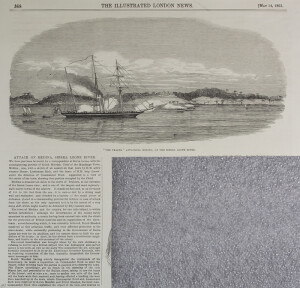 | ADDITIONAL INFORMATION: "The Illustrated London News, " May 14, 1853, p. 368. | CL18191 | |||||||
| 45 | No image URL. | Eastland (Screw schooner : 1903). | Chicago (Ill.)–History–1875-. | Steamboat disasters–Illinois–Chicago River.; Shipwrecks–Illinois–Chicago River.; Trials (Manslaughter)–Illinois–Chicago.; Trials (Conspiracy)–Illinois–Chicago. | Ashes under water : __the SS Eastland and the shipwreck that shook America __Michael McCarthy. | LB109422 | ||||
| 46 | 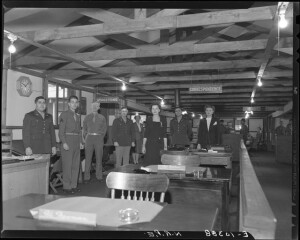 | 10/14/1944 | United States. Army–Inspection.; Port of Embarkation, Hampton Roads, Va. (U.S.). | Camp Patrick Henry (Va.). | E-10388 - W.O.J.G. Fred M. Cedarelli, Asst. Per. Off. Pers. Dir., CPH, W-2108057, home address - 64 Hawkins St., Derby, Conn., Sgt. Morris Musbaum, 32653870, Hq. Co. Sta. Comp., CPH, assigned to Mil. Br., home address - 643 Fox St., Bronx, N.Y., Pfc. Charles M. Robertson, 31348487, Hq. Co. S.C.B., CPH, assigned to Mil. Br., home address - 26 Jenkc St., Springfield, Mass., Capt. Preston M. DeForest, T.C. Asst. Chief. Mil. Br., 01944560, home address 136 Albion St., Holley, New York, Mrs. William Howell, Head Messenger Mil. Br., CPH, Home address, Red Hill Village, CPH, Mrs. Robert E. Forsythe, Clerk-Typist CAF-2, Mil. Br., home address - 331 Richmond Rd., Williamsburg, Va., Capt. Thomas E. Cottrell, 0-485413, Inf. Asst. Chief, Mil. Br., CPH, home address - 195 Maple Ave, Red Bank, N.J., Mrs. C. H. Hubbell, Jr., Clerk-Typist - CAF-2, Mil. Br., CPH, home address - 409 South Boundary St., Williamsburg, Va. Photo taken at CPH. 10-14-44 Official Photograph, U. S. Army Signal Corps, HRPE, Newport News, Va. | Offices–Virginia–Newport News.; Desks–Virginia–Newport News.; Office equipment and supplies–Virginia–Newport News. | Several officers in uniform and some in civilian suits stand in a building with exposed rafters. Beside them are desks with blotters, and naked bulbs with pull cords hang overhead. | P0003/01-#E-10388 | ||
| 47 | 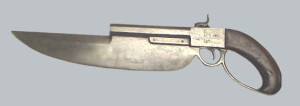 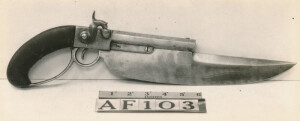 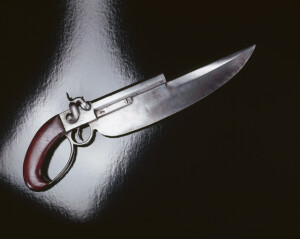 | SHORT DESCRIPTION: Elgin patent percussion cutlass pistol made by the Cyrus B. Allen company of Springfield, Massachusetts and the Ames Manufacturing Company in 1837. The gun, serial number 5, is marked “Elgins Patent” and “CBA” for maker Cyrus B. Allen of Springfield, Massachusetts. Other marks on the top of the gun are “PM”, the initials of the US Inspector of Contract Arms, and the date “1837”. The number “5” is stamped on the blade and side of the barrel. The pistol has a 5-inch, smoothbore, octagonal barrel and a rounded trigger guard. The 11-inch bowie-knife blade is attached to the bottom of the gun barrel and points forward so that the pistol handle also serves as the knife handle. The top edge of the cutlass is beveled. The pistol has an elongated finger guard that stretches from the trigger guard to the wooden butt. NOTES: The Bowie-knife became popular after James Bowie’s Sandbar Fight in 1827 on the Mississippi River near Natchez. During the fight Bowie was stabbed and shot twice but still managed to kill Norris Wright, the Sheriff of Rapides Parish, with a large knife. Bowie then reinforced his fame by dying at the Alamo in 1836, reputedly still with his knife in his hand. On July 5, 1837, New York’s George Elgin patented his pistol-knife or pistol-cutlass, a combination of two weapons a single-shot pistol and a knife or cutlass in a single weapon. Elgin cutlass pistols were manufactured by Cyrus B. Allen of Springfield, Massachusetts and Morrill, Mosman & Blair of Amherst, Massachusetts. The pistols made for civilian sale varied in size from .35 to .41-caliber and were usually fitted with rifled or smoothbore barrels 4 to 5 inches long and knife blades 7-1/2 to 10-1/2 inches long. The Ames Manufacturing Company in Cabotville made the blades for the C.B. Allen pistols. Elgin believed that the combination of pistol and cutlass would better arm sailors for battle and marketed the weapon to the US Navy. In 1838, the US Navy purchased 150 .54-caliber cutlass pistols for use in the U.S. Exploring Expedition (also called the Wilkes Expedition and South Seas Exploring Expedition). The guns had 5-inch smoothbore octagonal barrels and 11-inch blades, with an overall dimension of 17 inches. The pistol had an elongated finger guard that stretched from the trigger guard to the butt. The Elgin cutlass-pistol was the first official percussion handgun used by the US Military and was the only combination gun ever issued to US military servicemen. NOTES: Originally authorized in 1828, the US Exploring Expedition was composed of six vessels, with a complement of scientists, under the command of Lt. Charles Wilkes. The expedition left Hampton Roads, Virginia on August 18, 1838. It landed at Madeira before rounding South America touching at several locations. It then proceeded to the South Pacific where it explored numerous islands including Tahiti, Samoa, New South Wales and Sydney, Australia. The expedition then sailed in the Antarctic Ocean and explored the Antarctic continent charting 1500 miles of coastline. The expedition proceeded back to the South Pacific and explored Tonga, Nuku'alofa and Fiji where members of the crew encountered hostile natives at Malolo. Several Americans and about eighty Fijians were killed. On the expedition's return it explored the west coast of the United States, continued to explore a number of Pacific islands before heading back to the US by way of the Cape of Good Hope. Nineteen scientific volumes were published after the fleets return and the expedition played a major contribution in the advancement of the U.S. scientific community. This weapon is mentioned several times in the expedition's narrative, which is titled "Narrative of the United States exploring expedition. During the years 1838, 1839, 1840, 1841, 1842." The only time the weapon was used in anger is on page 270 of Volume III: While on the island of Malolo in Fiji, the Americans encountered hostile natives. When a landing party was attacked on the beach, Midshipman Wilkes Henry pursued a native and cut him down with his "bowie-knife pistol." Henry then shot another native just as he was struck with a club on the back of his head and killed. On page 187 in Volume V: While a party from the expedition was exploring the Sacramento river they camped with some indians. The next morning "when the party were breaking up camp to embark, an Indian boldly seized the bowie-knife-pistol of Dr. [Charles] Pickering” [a naturalist with the expedition] and escaped into the woods. On page 338-339 in Volume V: While the expedition was at Jolo (Wilkes calls it 'Sooloo') in the Philippines, Mr. James D. Dana, the mineralogist with the expedition "had for a moment laid down [his bowie-knife] on a chest" while in the governor's house. Wilkes concluded that it had been stolen and determined to the governor responsible for the theft, stating that the pistol must be returned before the next morning or he must face the consequences. That evening Wilkes ordered one of the long guns to be fired towards the town “believing that the sound and reverberation alone would suffice to intimidate such robbers.” The gun’s report “fairly shook the island” and Wilkes was sure the gun would be returned the next day. At daybreak Wilkes was informed by a special messenger from the governor that the pistol had been found and would be returned without delay. NOTES: Excerpts from blog post “Ames Manufacturing Company, Chicopee, Mass” by Derek Strahan, published on July 12, 2018 on Lostnewengland.com and from “The Ames Century, 1829-1929” published in Man at Arms in November/December 1980. In 1829 industrialist Edmund Dwight persuaded brothers Nathan Peabody (1804-1847) and James Tyler Ames (1810-1883) to relocate their cutlery business from Chelmsford to Chicopee Falls, Massachusetts. By 1833 the Ames company had expanded and was producing a wide variety of cutlery and tools and swords for the Army and Navy. In 1834 the company was incorporated as the Ames Manufacturing Company. In 1835 the company moved downriver to Cabotville, a village that would later become the center of Chicopee when it was incorporated as a separate town in 1848. In 1836 a bronze foundry was established in which cannon and sword parts could be cast. The Ames Manufacturing Company pioneered electro-plating in America in the late 1830s. The company continued to grow and by the late 1830s was also producing cannons, cannonballs, bells and a variety of other metal objects. In the 1840s, an expansion of its facility was earmarked for the production of arms for the Navy; a breech-loading carbine designed by William Jenks and a box-lock percussion pistol. The corporation divested itself of the Jenks contract in 1849. In the 1840s and 1860s, the company provided munitions to the government. In June 1861 Ames received contracts for 17,000 swords (10,000 cavalry sabres; 5,000 artillery sabres; 1,000 artillery swords; 3,000 NCO swords; 3,000 musician swords; 1,500 mounted officer swords; 3,000 foot officer swords; and 300 staff officer swords). Another flood of contracts followed eventually amounting to 154,224 swords by the end of the war (34% of the Ordnance Officer sword purchases from 1861-1865). Also produced were bronze howitzers, heavy iron siege and coastal defense guns, coehorn mortars and a variety of ordnance projectiles. Nathan died in 1847 but James remained with the company until his retirement in 1872. While the Civil War had been a boon for business, afterwards the company struggled to adapt to peacetime demands. The company produced a wide array of metal products and in the 1870s had major foreign contracts for bayonets, scabbards and sabers. The company continued to decline and in 1908 the factory complex was sold to A. G. Spalding and Brothers, a sporting goods company established by Albert G. Spalding. | CL1514 | |||||||
| 48 | 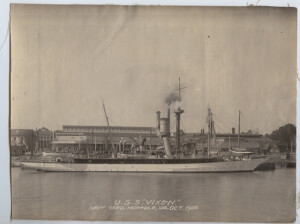 | 10/1900 | Amphitrite (Ironclad : 1897).; Norfolk Naval Shipyard (U.S.).; Vixen (Yacht : 1899). | WRITTEN ON PHOTOGRAPH: U.S.S. VIXEN, NAVY YARD, NORFOLK VIRGINIA, OCTOBER 1900 | Starboard side view of US yacht Vixen at the Norfolk Naval Shipyard. Tied up portside of Vixen and in the background of this photograph is the US monitor Amphitrite, to which Vixen is acting as tender. From Wikipedia, Career (USA) Name: USS Vixen Namesake: A female fox. Owner: Philadelphia, Pennsylvania, financier Peter Arrell Brown Widener Builder: Lewis Nixon, Elizabethport, New Jersey Laid down: date unknown Launched: 1896 Acquired: 9 April 1898 Commissioned: 11 April 1898 at the Philadelphia Navy Yard Recommissioned: 2 April 1917 Decommissioned: 15 November 1922 Struck: 9 January 1923 Fate: sold on 22 June 1923 General characteristics Type: schooner-rigged, steam yacht Displacement: 806 long tons (819 t) Length: 182 ft 3 in Beam: 28 ft 0 in Draft: 12 ft 8 in (mean) Propulsion: steam engine and schooner sail Speed: 16.0 knots Complement: 82 officers and enlisted Armament: four 6-pounder guns four 1-pounder guns Armor: steel-hulled For other ships of the same name, see USS Vixen. USS Vixen (PY-4) was a yacht acquired by the U.S. Navy for operations in the Spanish-American War, where she served with distinction during the Battle of Santiago. She was commissioned again for duty during World War I when she was assigned to patrol the U.S. East Coast. Commissioned at the Philadelphia Navy Yard Josephine—a steel-hulled, schooner-rigged, steam yacht—was built in 1896 at Elizabethport, New Jersey, by Lewis Nixon and, at the time of her acquisition by the U.S. Navy on 9 April 1898, was owned by the Philadelphia, Pennsylvania, financier Peter Arrell Brown Widener. Renamed Vixen, the erstwhile pleasure craft was armed and fitted out for naval service at the Philadelphia Navy Yard where she was commissioned on 11 April 1898, Lt. Alex Sharp in command. Spanish-American War service[edit] A ship of many talents..Assigned to the North Atlantic Station, Vixen sailed for Cuban waters on 7 May and arrived off the coast of Cuba nine days later. For the duration of the "splendid little war", the graceful armed yacht performed a variety of duties, blockading and patrolling, carrying mail and flags of truce, ferrying prisoners, establishing communications with Cuban insurgents ashore, and landing reconnaissance parties. Among her passengers embarked during that time was Colonel (later President) Theodore Roosevelt, of the famous "Rough Riders". Also aboard during that time period was Midshipman, later Admiral, Thomas C. Hart. Arthur MacArthur III, General Douglas MacArthur's brother, served on Vixen during the Battle of Santiago. The Battle of Santiago, Cuba between 13 and 17 June 1898, she took part in the bombardment of Santiago, Cuba, and, on 3 July 1898, took part in the Battle of Santiago. On the latter occasion, the highlight of the ship's operations during the Spanish-American War, Vixen was patrolling off Santiago between 0935 and 0945 and was at a point some four miles[vague] to the westward of the distinctive landmark, the Morro Castle. At about 0940, a messenger reported to the captain, Lt. Sharp, that there had been an explosion inside the entrance to the harbor. Rushing on deck, Sharp almost immediately sighted the first Spanish vessel to sortie—the armored cruiser Vizcaya. Photograph of USS Suwanee underway off Siboney, Cuba, during the Spanish-American War. Ships in the background include USS St. Louis (left) and USS Vixen (right).[edit] Vizcaya fires on VixenSharp ordered full speed ahead and hard-a-port, a move taken in the nick of time because shells from his own ships—alerted to the sortie of Admiral Cervera's fleet—splashed in the water astern in the yacht's frothing wake. Vizcaya acknowledged the presence of the yacht in the vicinity when she sent a salvo toward her with her starboard bow guns. Fortunately for Vixen, the shells passed overhead, "all being aimed too high." As Vixen gathered speed, she steered south by east, clearing the armored cruiser Brooklyn's field of fire, about two points on Vixen's port bow. The yacht then steered west by south, as Sharp wanted to steer a course parallel to that of the Spanish fleet that was then under fire from the other American ships. Unfortunately, the helmsman erred and steered southwest by south—a mistake not discovered until Vixen had steered farther from the action. Meanwhile, Brooklyn had engaged the leading ships of the Spanish fleet and was trading shell for shell in a spirited exchange of fire. Shells from Cristobal Colon passed over Brooklyn. One splashed "close ahead" and another splashed astern on the yacht's starboard beam. Several others passed directly overhead, a piece of bursting shell going through Vixen's battle flag at her mainmast. Vixen fires on Vizcaya,m Vixen witnessed the battle as it unfolded, but, as her commanding officer observed, ". . . seeing that the Spanish vessels were out of range of our guns while we were well within range of theirs, we reserved our fire." In fact, Vixen did not fire upon the enemy ships until 1105, when she opened fire on the badly battered Vizcaya, which had gone aground, listing heavily to port. Vixen's fire was short-lived for Vizcaya's flag came down at 1107, and Lt. Sharp ordered cease fire. The yacht remained underway to participate in the chase of the last remaining heavy unit of the Spanish fleet, Cristobal Colon, until that Spanish warship struck early in the afternoon. After the conclusion of hostilities with Spain later that summer, Vixen returned to the United States, reaching Staten Island, New York, on 22 September. She then shifted southward to Norfolk, Virginia, arriving there on 19 October. Subsequently placed in reserve there on 18 January 1899, Vixen was recommissioned on 17 March, sailing for Key West, Florida, and the Caribbean on 21 May. Post-war service for the next seven years, Vixen operated in waters off Puerto Rico, conducting surveys, carrying mail, stores, and passengers for the fleet, interspersing those miscellaneous duties with annual voyages to Norfolk for overhauls. During that time, she also briefly served as tender for Amphitrite (Monitor No. 2), the station ship at Guantanamo Bay, and later herself held the assignment of station ship there. Her diligent service was often rewarded with commendations for the excellence of her surveying activities. She often carried out her duties in completely uncharted waters and under a variety of weather conditions. World War I service decommissioned at Pensacola, Florida, on 30 March 1906, Vixen remained there until 6 December 1907, when she was turned over on loan to the New Jersey State Naval Militia. Serving with that force until the American entry into World War I, Vixen was recommissioned on 2 April 1917. She patrolled off the eastern seaboard and, following the establishment of United States naval activities in the recently acquired Virgin Islands (purchased from Denmark), served as station ship at St. Thomas. Subsequent decommissioning and sale during her tour at that West Indian port, Vixen was classified as a converted yacht, PY-4, on 17 July 1920. Ultimately decommissioned on 15 November 1922, Vixen was struck from the Navy list on 9 January 1923. She was subsequently sold on 22 June 1923 to the Fair Oaks Steamship Corp., of New York City. References: This article incorporates text from the public domain Dictionary of American Naval Fighting Ships. The entry can be found here. | MS0538/-02.01#084 | ||||
| 49 | 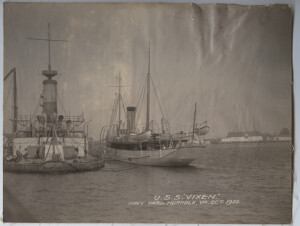 | 10/1900 | Amphitrite (Ironclad : 1897).; Norfolk Naval Shipyard (U.S.).; Vixen (Yacht : 1899). | WRITTEN ON PHOTOGRAPH: U.S.S. VIXEN, NAVY YARD, NORFOLK VIRGINIA, OCTOBER 1900 | Stern view of US monitor Amphitrite (left) and tender US yacht Vixen at dock in the Norfolk Navy Yard. From Wikipedia: Name: USS Vixen Namesake: A female fox. Owner: Philadelphia, Pennsylvania, financier Peter Arrell Brown Widener Builder: Lewis Nixon, Elizabethport, New Jersey Laid down: date unknown Launched: 1896 Acquired: 9 April 1898 Commissioned: 11 April 1898 at the Philadelphia Navy Yard Recommissioned: 2 April 1917 Decommissioned: 15 November 1922 Struck: 9 January 1923 Fate: sold on 22 June 1923 General characteristics Type: schooner-rigged, steam yacht Displacement: 806 long tons (819 t) Length: 182 ft 3 in Beam: 28 ft 0 in Draft: 12 ft 8 in (mean) Propulsion: steam engine and schooner sail Speed: 16.0 knots Complement: 82 officers and enlisted Armament: four 6-pounder guns four 1-pounder guns Armor: steel-hulled For other ships of the same name, see USS Vixen. USS Vixen (PY-4) was a yacht acquired by the U.S. Navy for operations in the Spanish-American War, where she served with distinction during the Battle of Santiago. She was commissioned again for duty during World War I when she was assigned to patrol the U.S. East Coast. Commissioned at the Philadelphia Navy Yard Josephine—a steel-hulled, schooner-rigged, steam yacht—was built in 1896 at Elizabethport, New Jersey, by Lewis Nixon and, at the time of her acquisition by the U.S. Navy on 9 April 1898, was owned by the Philadelphia, Pennsylvania, financier Peter Arrell Brown Widener. Renamed Vixen, the erstwhile pleasure craft was armed and fitted out for naval service at the Philadelphia Navy Yard where she was commissioned on 11 April 1898, Lt. Alex Sharp in command. Spanish-American War service[edit] A ship of many talents..Assigned to the North Atlantic Station, Vixen sailed for Cuban waters on 7 May and arrived off the coast of Cuba nine days later. For the duration of the "splendid little war", the graceful armed yacht performed a variety of duties, blockading and patrolling, carrying mail and flags of truce, ferrying prisoners, establishing communications with Cuban insurgents ashore, and landing reconnaissance parties. Among her passengers embarked during that time was Colonel (later President) Theodore Roosevelt, of the famous "Rough Riders". Also aboard during that time period was Midshipman, later Admiral, Thomas C. Hart. Arthur MacArthur III, General Douglas MacArthur's brother, served on Vixen during the Battle of Santiago. The Battle of Santiago, Cuba between 13 and 17 June 1898, she took part in the bombardment of Santiago, Cuba, and, on 3 July 1898, took part in the Battle of Santiago. On the latter occasion, the highlight of the ship's operations during the Spanish-American War, Vixen was patrolling off Santiago between 0935 and 0945 and was at a point some four miles[vague] to the westward of the distinctive landmark, the Morro Castle. At about 0940, a messenger reported to the captain, Lt. Sharp, that there had been an explosion inside the entrance to the harbor. Rushing on deck, Sharp almost immediately sighted the first Spanish vessel to sortie—the armored cruiser Vizcaya. Photograph of USS Suwanee underway off Siboney, Cuba, during the Spanish-American War. Ships in the background include USS St. Louis (left) and USS Vixen (right).[edit] Vizcaya fires on VixenSharp ordered full speed ahead and hard-a-port, a move taken in the nick of time because shells from his own ships—alerted to the sortie of Admiral Cervera's fleet—splashed in the water astern in the yacht's frothing wake. Vizcaya acknowledged the presence of the yacht in the vicinity when she sent a salvo toward her with her starboard bow guns. Fortunately for Vixen, the shells passed overhead, "all being aimed too high." As Vixen gathered speed, she steered south by east, clearing the armored cruiser Brooklyn's field of fire, about two points on Vixen's port bow. The yacht then steered west by south, as Sharp wanted to steer a course parallel to that of the Spanish fleet that was then under fire from the other American ships. Unfortunately, the helmsman erred and steered southwest by south—a mistake not discovered until Vixen had steered farther from the action. Meanwhile, Brooklyn had engaged the leading ships of the Spanish fleet and was trading shell for shell in a spirited exchange of fire. Shells from Cristobal Colon passed over Brooklyn. One splashed "close ahead" and another splashed astern on the yacht's starboard beam. Several others passed directly overhead, a piece of bursting shell going through Vixen's battle flag at her mainmast. Vixen fires on Vizcaya,m Vixen witnessed the battle as it unfolded, but, as her commanding officer observed, ". . . seeing that the Spanish vessels were out of range of our guns while we were well within range of theirs, we reserved our fire." In fact, Vixen did not fire upon the enemy ships until 1105, when she opened fire on the badly battered Vizcaya, which had gone aground, listing heavily to port. Vixen's fire was short-lived for Vizcaya's flag came down at 1107, and Lt. Sharp ordered cease fire. The yacht remained underway to participate in the chase of the last remaining heavy unit of the Spanish fleet, Cristobal Colon, until that Spanish warship struck early in the afternoon. After the conclusion of hostilities with Spain later that summer, Vixen returned to the United States, reaching Staten Island, New York, on 22 September. She then shifted southward to Norfolk, Virginia, arriving there on 19 October. Subsequently placed in reserve there on 18 January 1899, Vixen was recommissioned on 17 March, sailing for Key West, Florida, and the Caribbean on 21 May. Post-war service for the next seven years, Vixen operated in waters off Puerto Rico, conducting surveys, carrying mail, stores, and passengers for the fleet, interspersing those miscellaneous duties with annual voyages to Norfolk for overhauls. During that time, she also briefly served as tender for Amphitrite (Monitor No. 2), the station ship at Guantanamo Bay, and later herself held the assignment of station ship there. Her diligent service was often rewarded with commendations for the excellence of her surveying activities. She often carried out her duties in completely uncharted waters and under a variety of weather conditions. World War I service decommissioned at Pensacola, Florida, on 30 March 1906, Vixen remained there until 6 December 1907, when she was turned over on loan to the New Jersey State Naval Militia. Serving with that force until the American entry into World War I, Vixen was recommissioned on 2 April 1917. She patrolled off the eastern seaboard and, following the establishment of United States naval activities in the recently acquired Virgin Islands (purchased from Denmark), served as station ship at St. Thomas. Subsequent decommissioning and sale during her tour at that West Indian port, Vixen was classified as a converted yacht, PY-4, on 17 July 1920. Ultimately decommissioned on 15 November 1922, Vixen was struck from the Navy list on 9 January 1923. She was subsequently sold on 22 June 1923 to the Fair Oaks Steamship Corp., of New York City. References; this article incorporates text from the public domain Dictionary of American Naval Fighting Ships. The entry can be found here. | MS0538/-02.01#085 | ||||
| 50 | No image URL. | United States–Antiquities–Collection and preservation. | Cultural property–Protection–United States.; Indians of North America–Antiquities–Collection and preservation.; Archaeological thefts. | Protecting the past __ __edited by George S. Smith and John E. Ehrenhard | LB106976 | |||||
| 51 | 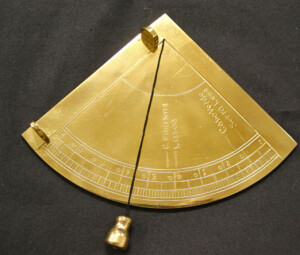 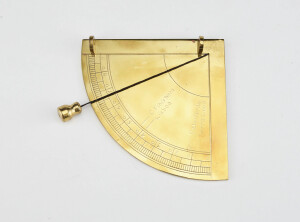 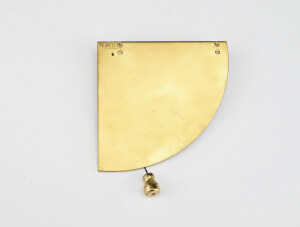 | SHORT DESCRIPTION: Scale on brass 0 to 90 in whole degrees. Peep sights and turned brass plumb bob. Engraved with the altitude of Polaris at Serra Leoa, Cabo Verde, Lisboa and C. Finisterra. Walnut stand. See Peter Ifland, From Taking the Stars. (Newport News, 1998), p.5. ADDITIONAL INFORMATION: Text of brochure that accompanies instrument: The Mariners' Quadrant, The Mariner's Quadrant is one of the oldest and simplest instruments for measuring the altitude of stars. It was widely used by the Portuguese navigators in Columbus' time. On leaving port the navigator would measure the altitude of Polaris using his quadrant. To return home he would sail north or south until Polaris was at the same altitude measured when he left port. At that point, he simply sailed east or west keeping the altitude of Polaris constant until he reached home. He would frequently mark the altitude of Polaris on his quadrant at home port or at any port to which he might wish to return. The quadrant illustrated here is marked with the altitude of Polaris at several of the ports Columbus frequently visited--Cape Verde and Sierra Leone along the coast of Africa and Finisterra and Lisbon on the Portuguese coast. The quadrant shows a reading on the scale of 24 degrees [in the illustration]. This is the altitude of Polaris that Columbus would have observed on the morning of October 12, 1492 at his first sight of land in the New World, now believed to be Watling Island in the Bahamas. Text of article that accompanied instrument: Christopher Columbus, How He Got There and Back: Many foolish sailors and fishermen sailed off into the unknown sea and never found their way back to home port. The smart navigators like Christopher Columbus and Vasco de Gama used the simple techniquest of navigation by the sun and stars to bring them and their ships safely home. The oldest trick of determining latitude, the north-south position on the Earth's surface, is to measure the angle of Polaris, the North Star, above the horizon. This technique was developed hundreds of years before Columbus' time by Arab and Persian sailors traveling along the coast of India and the east coast of Africa. They wuold measure the angle of Polaris above the horizon using a simple instrument made of string and a stick. To return to port after a long voyage, they sailed north or south until Polaris was at the height they measured when they left home. They then turned left or right, keeping Polaris at a constant height, and sailed along until they reached home port. By 1492, the instruments for measuring the altitude of Polaris were much more sophisticated. The quadrant, the cross staff, and the mariner's astrolabe were popular among the Portuguese navigators. The technique of determining latitude by the noon observation of the sun was just coming into use. The determination of longitude, the east-west position on the Earth, came three hundred years later with the development of accurate, sea-going clocks. Some of the very old instruments, such as those used by Christopher Columbus, are in national museums and are too rare and expensive for private collectors. Nautica Instrument Company was established to produce museum quality replicas in limited editions of some of these instruments of special historic significance. Peter Ifland, November, 1991. Text of article that accompanied instrument: Christopher Columbus, The Story of his First Voyage To The New World: It is not surprising that Cristoforo Colombo should lead a life of exploration and adventure on the sea. Genoa, Italy, where he was born in 1451, was a thriving sea port--a hub of prosperous commerce throughout the Mediterranean. While still in his early teens, he when to sea on the ships that brought wool and wine to supply his father's businesses. At age 20, he commanded a Genoese galley ship fighting against the pirates of Tunis who were threatening merchant ships sailing back and forth across the Mediterranean. In May, 1476, young Columbus sailed on a Genoese convoy headed to Flanders and England. In one of those minor events that ultimately shaped history, the convoy was attacked by French pirates as it rounded the coast of Portugal. Columbus' ship was sunk and he had to swim for shore. He landed at Lagos and made his way to Lisbon where there was a well established community of Genoese merchants. Columbus settled in Lisbon where he continued his life as a merchant and mariner. It was an exciting time in Portugal. The country, with enthusiastic support from the King, was caught up in an unparalleled period of exploration and discovery. During this time Columbus made many voyages with the Portuguese seamen. He sailed as far North as Ireland and Iceland and as far south down the west coast of Africa as Sierra Leone. Contrary to modern tales, it was already broadly accepted in Columbus' time that the earth was round. The question of the times was what was the diameter of the earth and how far west of Europe was China, India and the Orient. Columbus grossly underestimated the size of the Earth. He calculated that Japan was 2,400 miles west of the Canary Islands when, in fact, Japan is 10,600 miles west of the Canaries! Columbus proposed his "Enterprise of the Indies" to King John II of Portugal in 1784. This plan, outlining a voyage westward to establish a trade route to China, was rejected by the King's Maritime Commission as impractical. Columbus left Portugal in 1484, moved to Spain and petitioned King Ferdinand and Queen Isabella to support his plan. The Spanish monarchs were preoccupied with a war to drive the Moors out of Granada. It wasn't until January of 1492 when the Moors were defeated that the royal attention could turn to less pressing matters such as Columbus' proposal. Columbus had given upon the Spanish and was on a mule headed for France when Isabella's messenger caught up with him to tell him his plan would receive royal support. Isabella provided about $14,000 from the Royal Police Force treasury to fund the project. The Nina and Pinta were provided by the port of Palos on the South coast of Spain, just outside the gates of Gibraltar. Use of the two ships was in payment of a fine imposed by the Crown. Columbus chartered the Santa Maria from a private owner to use as his flagship. The three ships carried a total of 90 men, mostly professional seamen. The fleet sailed from Palos early on the morning of Friday, August 3rd, 1492. After a stopover for a few days in the Canaries, which Columbus thought was about the latitude of Japan, they set sail on a westerly course on September 6th. The favorable winds blowing steadily out of the East at these latitudes pushed the ships briskly across the open ocean, so much that the crew became concerned that they would not be able to find a favorable wind to carry them back home. On the 7th of October, Columbus changed course slight to the southwest and five days later, early on the morning of October 12th, land was sighted. The best estimate is that the first landing in the New World was on the island now known as Watling Island in the Bahamas. He named this island San Salvador. Columbus was convinced that he has sailed past Japan and that China was only a few days sail further west. He sailed to the north west and soon landed in Cuba. So convinced was he that he had landed in Asia that he sent out emissaries with a message of greeting to the Great Kahn, Emperor of China. When the delegations returned empty handed, the fleet set sail eastward. They promptly discovered the large island we now know as Haiti and the Dominican Republic. Columbus named the island Hispanola and claimed it for the King of Spain. The return trip eastward back to Spain was not nearly as easy as the sail westward had been. The Santa Maria was lost on a reef on Christmas Eve, 1492 and the two remaining ships encountered a severe storm in the Azores. Another storm drove them northward past the entrance to the Mediterranean at Gibraltar and on to Lisbon. While in Lisbon, Columbus visited King John who earlier had refused to finance Columbus' explorations. This time, when Columbus told King John what he had found, the King tried to claim the discoveries for Portugal but his claim was ultimately unsuccessful. Columbus returned to Palos on March 14, 1493, more than seven months after he set sail. He traveled overland by cavalcade across Spain to Barcelona. Here he was received by the Royal Court with all the honor and celebration he had so rightfully earned. Columbus made three more voyages to the western Atlantic. It was not until his third voyage, on landing on the mainland of the coast of Brazil, that he wrote in his journal on August 5, 1498: "I believe that this is a very great continent, until today unknown." How right he was! Peter Ifland, 1991. | CL26252 | |||||||
| 52 | 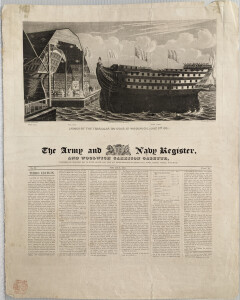  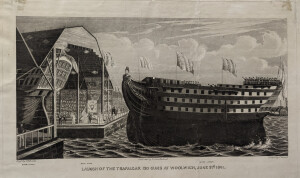 | NOTES: Page from The Army and Navy Register, and Woolwich Garrison Gazette, published by Edward Jones, Thomas Street, Woolwich. This is issue number 12, for July 1841. TEXT: The Army and Navy Register, And Woolwich Garrison Gazette, Published on the First day of Every Monty, and Upon All Extraordinary Occasions, By E. Jones, Thomas Street, Woolwich, No. 12, For July, 1841. Price 1S., Third Edition. LAUNCH OF THE TRAFALGAR. [First column] The announcement of the certainty that Her Majesty and Prince Albert would be present at the launch of this splendid vessel, induced many thousands of the inhabitants of the Metropolis to visit Woolwich to witness the interesting spectacle. On Sunday evening the number of persons who arrived at Woolwich was unexampled on any former occasion, and consequently every house of public resort or where a stranger could claim the slightest relationship or acquaintance with the occupiers, was besieged to obtain beds, or temporary accommodation for the night. The morning of June 21, having a favourable appearance, at the earliest hour groups of respectably dressed strangers were perambulating the streets, and in the course of the morning the whole of the inhabitants of the town were in motion, especially the middle classes, notice having been given that the workmen employed in any department of Her Majesty's service, might introduce their families to the open space and to back seats erected for them if they attended by nine o'clock at latest. As early as seven o'clock hundreds occupied the seats allotted to them and kept them with the greatest patience for nearly seven hours until the launch took place, and by nine o'clock the whole were densely crowded. Between nine and ten o'clock, carriages containing parties having tickets of admission at the main gate, began to arrive and continued to set down for a long period. The steam boats also brought thousands after thousands and continued to land passengers at the various wharfs without intermission for upwards of three hours Between one and two o'clock numbers of large steam vessels arrived and took up their stations in the river, and it was evident many of them contained from a thousand to twelve hundred persons each, being very crowded in every available part, even to the rigging. The arrangements of the harbour- [Second column] master, and those under his charge, and the river police, afforded the various steam boats as they arrived, an opportunity to run close to the stern of the vessel and then to fall back into the station they were to occupy during the launch, which gave great satisfaction to the public. On the Essex side, the banks of the river presented a most animating scene, being crowded to an extent of upwards of a mile and half with parties who had a good distant view of the launch. Early in the morning orders were issued to the troops in the garrison, to assemble on parade at 12 o'clock, under arms and in review order, and at that hour they were: marched to the Dock Yard, headed by the Royal Horse Artillery, commanded by Col. Dyneley, to keep a clear passage on Her Majesty's approach, and the others to occupy such positions as would be pointed out to them by the Brigade Major. The company of Gentlemen Cadets to form Her Majesty's guard of honour, under the command of Captain Burnaby The Royal Marines, with band and colours, to form the guard of honour of His Royal Highness, the Duke of Cambridge. The band of the 15th regiment to be stationed within the enclosure, at the head of the ship. The band of the Royal Sappers and Miners to be stationed on board Her Majesty's ship Trafalgar. No person to be admitted on horseback except Lieut.-General Lord Bloomfield, his staff, and the officers on duty with the troops. The Royal Foot Artillery commanded by Colonel Lacy, and the right and left wings by Lieut.-Colonel Brandreth, and Lieut. Colonel Jackson. The 15th regiment was commanded by Lieut.-Colonel Lord Charles Wellesley. The Royal Marines, by Colonel Connolly. At half past one o'clock the band of the Royal Marines played the national anthem, on the arrival of Prince Gorge and the Duchess of Cambridge. His Royal Highness passed through the Royal Marines, and was escorted to his seat by Lord Bloomfield. The seat occupied by the Duchess of Cam- [Third column] bridge, and Prince George of Cambridge, was immediately opposite the royal stand, and next to the river, on the east side of the stern of the vessel. The royal marine band was then stationed there, and performed a number of fine airs. Precisely at two o'clock a royal salute fired at the mortar and howitzer battery, announced the near approach of Her Majesty and the royal party, escorted by a detachment of 11th hussars. Her Majesty was received by Lord Minto, Sir Charles Adam, Lords of the Admiralty, Admiral Beauclere, Admiral Digby, Admiral Otway, Captain Phipps Hornby, Superintendent of the Dock Yard, Lieut.- General Lord Bloomfield, and his staff, the Gentlemen Cadets forming the guard of honour, and the band of the Royal Artillery playing "God Save the Queen." On entering the spacious portion of the building, under which the Trafalgar was constructed, which was decorated with standards and a royal crown, placed over the inside of the door, with a profusion of union jacks, and a flag, with the arms of Saxe Coburg and Gotha, Her Majesty appeared to be enraptured with the scene presented to her view, the magnificence of the vessel on one side, and the immense groups of her affectionate subjects in the vessels on the river, and on the banks on the opposite side, who welcomed her with most enthusiastic cheers. Her Majesty after sitting for a few minutes on a crimson covered couch, proceeded to the front of the vessel, leaning on the arm of Lord Minto, and followed by Prince Albert, Colonel Bowater, Colonel Wylde, and other officers, and equerries in waiting. At half past two Her Majesty having previously returned to the royal stand, a salute was fired to announce that the launch would immediately take place, and the majestic vessel glided into the water, amidst the cheers of hundreds of thousands, who were gratified with the sight. At about 150 yards distant from the shore the anchor was dropped, and the Trafalgar brought up in beautiful style, the bands playing "Rule Britannia," and the brave old tars upon her decks cheering with their utmost strength. [Fourth column] Her Majesty remained in front of the Royal stand until three o'clock, affording many of the steam vessels an opportunity of coming alongside previous to their departure with her loyal subjects, and the Queen appeared to feel more than ordinary pleasure from the animated scene presented to her view on this imposing occasion. A heavy shower of rain prevented Her Majesty from going on board the Firebrand, as was originally intended, and after again walking along the interior of the building, Her Majesty went out at the south end, and having entered her carriage proceeded for Buckingham Palace. Admiral Sir James Gordon, Lieutenant Governor of Greenwich Hospital, was present in the Messenger, and the number of distinguished officers was very great, wherever a good view could be obtained. The crew of the Salamander, steam frigate, manned their yards, and the yachts of Admiral Codrington, the Marquis of Anglesea, Lord A. Paget, and many others were gaily decked with colours. It is gratifying to be able to state that the whole went off in the most admirable manner, without any serious accident. The following is a correct description and exact measurement of the Trafalgar, as she appeared at the time of the launch:- The bows and helm have been already coppered, and the portion above water has been fully painted outside and inside. The stern has been finished in a handsome manner, presenting a chaste and light appearance, similar betwixt the decks to the ballustrades on bridges. The upper deck is supported in the centre by 39 pillars of the best African teak, nearly as hard as iron, and 11 pillars of softer wood, next the stern. The second deck is supported by 21 pillars of African teak, 5 of hard wood and 12 of iron, and the lower deck by 35 pillars of African teak; and the beams on each deck are joined to the sides by immense joints of iron, presenting an appearance of the greatest strength and durability in all its parts. The outward dimensions of this splendid vessel, are as follows:-- [Fifth column] Length from the fore part of the figure to the after part of the stern 246 feet 2 inches. Length on the gun deck 205 feet 5-1/2 inches Length keel, for tonnage 170 feet 5 inches Breadth, extreme 55 feet 7-1/2 inches Breadth for tonnage 54 feet 9-1/2 inches Breadth Moulded 53 feet 11-1/2 inches Depth in Hold 23 feet 2 inches Burthen in Tons 2721 23/24 old measurement Burthen in tons 2553 [large fraction] new measurement Height from the lower part of the keel, to the upper part of the stern 54 feet 12-1/2 inches DEPARTURE OF THE TRAFALGAR FOR SHEERNESS. About ten minutes before two o'clock on the following day, this magnificent vessel, with the Royal Standard of England, and the Admiralty and other flags waving in the breeze, in the same positions as they were when she was launched, commenced her progress down the river, towed by the Salamander frigate, on her larboard side, the Monkey steam-vessel on the starboard side, and the Meteor steam-vessel right a-head. On her departure, numbers of persons who visited Woolwich for the purpose of seeing her, and the workmen in the dock-yard gave three hearty cheers, which were repeated along the densely crowded wharfs, as she slowly passed them, the tide being at the time running up. On passing the Royal Arsenal, the wharfs appeared crowded, and she was again cheered by the numerous workmen employed in that large naval and military establishment. It is a very gratifying circumstance connected with the launch of the Trafalgar, a day which will be long remembered in Woolwich, and by hundreds of thousands of the inhabitants of the metropolis, who, from the facilities of steam and railway conveyance, witnessed her graceful and gentle entry into the bosom of Old Father Thames, that in no part of her timbers did she yield three quarters of an inch, an unparalleled event [Sixth column] in the annals of ship building, many frigates and even smaller vessels having yielded 8 or 9 inches on such occasions, as has been proved by the plans usually adopted to ascertain their strain. The Trafalgar in a masterpiece of art, and her elegant proportions afford convincing proofs of the superiority of British naval architects, and of Mr. Lang, under whose immediate superintendence she was constructed. Mr. Lang, immediately previous to the launch, had the honour of explaining to Her Majesty and Prince Albert the manner in which the ceremony of naming the vessel was performed. As various reports have been circulated, it may be proper to mention that Lady Bridport, a niece of the gallant Nelson had this honour most appropriately conferred upon her. The bottle of wine from which three glasses were drank before it was attached to the sling, by a singular coincidence had been in the store of the Victory the flag ship of the brave Nelson, at the battle of Trafalgar, having been presented for the occasion. Shortly after Her Majesty left the royal stand in which was a round table, on the centre of which was a handsome vase containing a nosegay, the ladies in the adjoining seats entered, and became possessed of the flower, and it was amusing to witness the anxiety to possess the smallest portion, some appearing delighted when they only obtained a leaf, from their early and more fortunate companions. Hundreds of elegantly dressed persons afterwards visited the Royal stand, and never on any former occasion had so many of Her Majesty's subjects such an excellent opportunity to witness under the most auspicious circumstances, their gracious sovereign, and never did Her Majesty appear so highly gratified as with the novelty of the scene, quite new to her and of so grand and imposing a nature. The keel of the Trafalgar was laid December 19th, 1829. WOOLWICH Printed and Published by Edward Jones, at his General Printing Office, Thomas Street, in the Town and Parish of Woolwich, the County of Kent, Wednesday, July 7, 1841. NOTE: John Grant (d.1873) produced a series of aquatints at Woolwich for illustrations of the Army and Navy Register and Woolwich Gazette, 1840–1855. Grant was apparently the editor of the Army and Navy Register at Woolwich. In 1841 Grant was at 34, Wellington Street. VESSEL INFORMATION - VESSEL HISTORY: Launched in 1841. Served in the Crimean War. Cut down and given engines in 1859. Seagoing cadet training ship in 1870. Stationary training ship at Portand in 1873. Sold in 1906. | CL20052 | |||||||
| 53 | SHORT DESCRIPTION: Builder’s half hull model, starboard side, made by Henry Steers of the schooner yacht Hope. The model is a basic representation of the vessel's molded lines, without constructional details. The model is not mounted on a backing board. It is varnished and inscribed in black-outlined letters “HOPE”. The stem has minimal rake and has a raked hour-glass shaped upper stern (no counter). It has moderate deadrise and little or no tumblehome. The model depicts a boat with deep draft aft and a keel that slopes up to the forefoot. It has a concave bow and a long sharp entry and a long run aft. The model is constructed of 9 lifts and two wedges, probably pine. The bottom lift is approximately 1-3/8” at the stern and tapers to zero about 28-1/2” from the stern. Lifts 2 through 8 are flat and 1/2” thick. Between lifts 8 and 9 there are two wedges, one at the bow and one at the stern. The wedge at the stern is 1-1/2” and tapers to zero 15-1/2” from the stern. The wedge at the bow is 1-15/16” and tapers to zero 17” from the bow. Lift 9 is the top covering of the model. It curves with the sheer formed by the two wedges. It is 27/32” high at the bow, 13/16” amidships, and ¼” at the stern. The dimensions of the model are 44-3/8” (length overall); 5-3/16” (main breadth), 5” (half breadth), leaving a tumblehome of just 3/16”. Height overall is 6-3/4” (at the stern). The minimum half-breadth of the model is 1/8" along the edge of the stem and stern. On the back of the model there are twenty-one penciled station lines running perpendicular to the lifts. The first station line is about 1" from the sternpost or 3-3/4" from the extreme end of the stern and the others are at roughly 13/16" intervals. There are twenty station lines penciled on the top of the model, the lines get very faint towards the bow so there may be more than twenty. They range in size from 13/16” to 1-7/8” apart. The lifts are held together with three wooden pegs and several screws. There are a few variously sized holes whose purpose is not apparent on the top and back of the model. The model is in fair to good condition. Lifts 2 through 5 are missing pieces at the stern: lift 2 is missing 1-3/4”, lift 3 and 4 are missing 1-7/8”, and lift 5 is missing 1”. The varnish is in good condition with no craquelure. There are minor scratches and dents scattered overall. There are thick scratches over the “P” in the yacht’s name. NOTES: The collection of half models MR 5 through MR 24 are of vessels built by shipbuilders Henry (father), James Rich and George (sons), and Henry Steers (son of James Rich), builders of the famous yacht America. The models document vessels built between 1805 and approximately 1876. They encompass all types of vessels from a catboat up to large steam sloop built for the US Navy. In a February 13, 1963 letter Howard I. Chapelle, Curator of the Division of Transportation at the Smithsonian stated “The Steers Collection is important technically and it is something we envy the Mariners’ Museum’s possession.” NOTES: Text from: Harper’s Weekly, May 11, 1878, page 369 for image (attached) and page 370 for description of new rig: OUR engraving of this handsome craft, shows the new rig adopted some time since for the New York pilot-boats. They are now rigged as nearly as possible like the beautiful and swift-sailing pleasure-yachts that enliven American waters during the summer season, with the modifications needful to fit them for the rough and tempestuous weather they may be compelled to encounter on the cruise for incoming vessels. Text from: Pilots, The World of Pilotage Under Sail and Oar, Vol. 1, Pilot Schooners of North America and Great Britain, pages 82-83. Shows lines drawn by Howard I. Chapelle and provides the following description of the image in Harper’s Weekly: The Hope was a powerful schooner driven hard by an enthusiastic crew. Behind her main boom is the fort on Governor’s Island and over her bowsprit is the Brooklyn Bridge under construction. She is seen here sporting a highly inventive addition to a schooner’s wardrobe, a square topsail on the mainmast. The sheet is led to the boom end like a fisherman staysail but, when arranged conventionally, these sails did not use a year. The lead of the tack is not visible, so perhaps this is some type of hybrid. VESSEL NAME: HOPE, HOPE No. 1 VESSEL TYPE: Schooner, Pilot schooner DESIGNER: Henry Steers BUILDER: Henry Steers BUILDER LOCATION: Greenpoint, Long Island, New York BUILD DATE: 1861 SHIPOWNER: Thomas Boynton Ives (1861); US Government (1861-1865?); New York pilots (1865-1891) SERVICE DATES: 1861 (US Revenue Yacht); 1861-1865 (US Dispatch boat); (1866-1891) pilot boat FATE: Wrecked on Sandy Hook Point March 13, 1891. DIMENSIONS: American Yacht List of 1874: 90’0” (overall length), 84’0” (waterline length), 21’6” (beam), 9’6” (depth), 10’ (draft); 132.40 tons (old), 59.62 tons (new) VESSEL HISTORY: • New York Daily Herald, March 11, 1861: New York Daily Herald (New York), March 11, 1861: At Greenpoint, Mr. Thomas Boynton Ives of Providence, is having built, by Henry Steers, a schooner yacht of one hundred and thirty tons measurement, which will take her rank among the first class boats of the squadron. She will be ready for her element on Tuesday next, when, Providence permitting, the launch will take place about ten o'clock in the morning. She has been christened "Hope," an emblem of the feeling predominant in every yachtsman's breast from the time his pet leaves the stocks until she has been beaten beyond all redemption. Her dimensions are as follows: Length on deck, 91 feet; beam, 21 feet 6 inches; depth, 8 feet 3 inches; length of masts, 74 and 76 feet; topmasts, 29 feet; bowsprit (outboard), 14 feet 6 inches; jib boom (outboard), 15 feet; main boom, 53 feet; fore do., 38 feet. Below, her fittings as regards both comfort and elegance are of the most substantial character. Forward are six berths for her crew with lockers and closets for the disposition of their wardrobes, and a dining table abaft the foremast. This apartment is separated from the kitchen by a bulkhead. The culinary department is of the most commodious character, embracing besides a range a four hundred gallon water tank, a refrigerator and provision locker, a thousand convenient little drawers, corners and crevices, which no one can use or appreciate as well as the cook, or, in maritime parlance, "the doctor." In the rear of the kitchen, and on either side of the passageway leading thence to the cabin, are staterooms and the pantry. Two of the former are fitted up as tastily as a ladies' parlor, are as large as many of our crack hotel attic bed chambers, and embrace all the comforts of a double bed, stationary washstand, drawers, closet, mirror, &c.--no mean belongings to any craft, the reader will echo who has lived on shipboard a month or six weeks. In the floor of one of these is the opening of a tank which holds six hundred gallons of water. On the opposite side of the passageway is the captain's stateroom; another of similar dimensions for extra company, and a pantry. The last includes an ice box and arrangements for dishes, silver and all the paraphernalia of what will readily be understood by the term of "a good time." The cabin is a large apartment, six feet two inches high, furnished in white and gold, and contains four berths, with supernumerary arrangements for improvising as many more. The decorations and upholstery are not yet complete; but they are far enough advanced to convey the most suggestive ideas of comfort and content. • New York Daily Herald (New York), March 14, 1861: Launch of the Yacht Hope. This new and beautiful schooner, of which we have heretofore given a full description, was launched at yesterday noon from the yard of Henry Steers at Greenpoint, L.I. A large "cloud of witnesses" were attracted to the scene, and the presence of a considerable number of ladies, the fluttering of the club signal from the masthead of the new yacht, and the display of bunting from the surrounding craft, invested the occasion with an aspect decidedly festive. The preparations for the launch were completed as early as eleven o'clock. The jib boom had been "housed" to prevent its contact with mother earth as the parting bow was made, riggers had done their work and departed, the few necessary stores, including two beautiful mahogany mounted brass guns, were sent on board, blocks were knocked away, the gangway plank removed, and the tiny vessel rested in her cradle, waiting only the command of the master to glide down the slippery ways into her future element. "Are you ready?" says a clear voice "Aye, aye, sir," is the response. Then "Go ahead!" and in an instant a dozen sledge hammers are driving the wedges to fasten her firmly in her place. This done, the supports beneath the keel are one by one removed, until nothing but her own weight holds the yacht in curb. Mr. Steers moves around to discover the cause of detention. Nothing is apparent, however, and he gives her the aid of a little impetus. A jackscrew is applied under the boat. Still she moves not. "Get out your battering rams," says the builder. A couple of these are accordingly improvised for the occasion from some of the surrounding timbers, and with tremendous force a dozen or twenty strong men drive them against the ends of the ways. They start an inch or two, and so do the crowd towards the end of the dock to see her touch the waters. But still the vessel sticks. A little more effort, and another inch is slowly gained, and another, and another, until, in half an hour, a whole foot has been moved over. The prospects begin to darken. The company on board peer anxiously over the side to see, if possible, what is the trouble. The master too is evidently disconcerted at the idea of a failure. A tugboat is near at hand, and some one proposes to pass a line to her from the yacht, and thus bring a new power to bear. This is accordingly done, and after a few efforts, aided by running up and down the decks of those on board, the yacht is finally started, and amid the cheers of the crowd and the smoke of her own salute, glides gracefully into the water. The new fledgling is a beautiful specimen of art in every sense of the word, and the builder and owner both received the encomiums of a large number of gentlemen connected with the New York Yacht Club. Among others present were the Vice Commodore, Moses H. Grinnell, C. T. Cromwell, and Captain Comstock, late of the Adriatic. • From The United States Revenue Cutters in the Civil War by Florence Kern, pages 8-3 to 8-9: Shortly after the start of the Civil War several yachtsmen in New York offered their services to the Union. Two yachts were accepted (as U.S. Revenue Yachts), James Gordon Bennett Jrs. new 158-ton schooner Henrietta and Thomas Boynton Ives schooner Hope. Both men were commissioned Lieutenant Commanders and given two NCO’s, ten men and $353 a month. Their duties would entail “the fitting out of slavers and other illicit trade” and intercepting vessels carrying “arms and munitions of war unless she is in the service of the United States.” The yachts were armed and dispatched in July 1861. Ives’ Hope was sent to Baltimore where he discovered the port being handled poorly and that “nothing whatever had been done to prevent vessels from leaving the port at any and all times and that after they left the dock no measures were taken to ascertain of what their cargo consisted.” He immediately began organizing a method for clearing and searching vessels. By the first of August they had boarded 150 sailing vessels. Ives was periodically ordered by General John Dix to examine particular steamships and seize any contraband: three trunks of military buttons and buckles were seized from the Mary Washington and eighty colt navy pistols, about 40,000 percussion caps and a third of a barrel of quinine in bottles were seized from the steamer George Weems. Within two weeks Ives had boarded about 39 vessels a day. Hope remained in the Chesapeake until October 11 when she was ordered to New York. On November 4th he asked to withdraw his yacht from the service and four days later she was decommissioned. • Philadelphia Inquirer, November 30, 1861: Despatch Boats for the South.—The yacht Hope, a fine schooner of one hundred and forty tons, was purchased in New York, on Thursday, for the Government. The yacht is present at Providence, R.I., and has been coasting in the revenue service during the past summer. She carries two guns, and can accommodate a crew of twenty-five men. The Hope will be sent to the Navy yard in a few days to receive her crew and stores. She will probably proceed to Port Royal, carrying mails and despatches. o September 12, 1862, Hope, acting master Breeze, was off Charleston. o February 10, 1863: The British schooner Emma Tuttle, from Nassau, with a cargo of salt, saltpetre and earthenware for the rebels, was also captured off Charleston on the 27th ult., by the Navy dispatch yacht Hope. A prize crew was put aboard her from the Keystone State. • Brooklyn Daily Eagle, January 23, 1866: The new pilot boat Hope No. 1, went on her trial trip yesterday down the Bay, steaming from the foot of Bridge Street, about 11 o’clock, with a number of Brooklyn citizens on board. The Hope was originally intended for a pleasure yacht, and was owned by Governor Sprague, of Rhode Island; but was, at the outbreak of the war, sold by him to the government, in which employ she has since been used for revenue and coasting purposes. She was purchased by the pilots for six thousand dollars, but has undergone extensive alterations, in fact has been almost entirely rebuilt, and is now better adapted for her new service. She is now valued at twenty thousand dollars. The following are her dimensions: length, 90 feet; breadth of beam, 21 feet; depth of hold, 9 feet 6 inches and 60 tons burden, new measurement. She is under the command of Captain Thomas Morley, one of the most experienced New York pilots, who is joint owner with Messrs. Carey, Lyons, Roach, Samson and Rush, pilots. The Hope rand down to Sandy Hook, and a few miles outside, proving an excellent sailer, and on the return her speed was tested by a race with the E. F. Williams, counted the fastest boat in the pilot service. The Hope beat the Williams easy, establishing her reputation as a crack boat of the fleet. The trip gave the guests some idea of the hardships of a pilot’s life, and at the same time a specimen of the hearty hospitality of the sailor. Some excitement was created by the hoisting of a green flag, with the sunburst—the Fenian banner, and gave rise to a rumor, gravely reproduced with big headlines in a morning paper, that Fenian privateer had sailed from New York. • The Buffalo Commercial, January 29, 1866 reported: The News a few days ago gave prominence to a statement that a Fenian privateer had slipped out of port and was prepared to do a large “gobbling up” business &c. It appears that a very fast sailing pilot boat, the Hope No. 1, left port for a short trip outside the Hook [this was actually the boat’s sea trials as a pilot boat], and the festive captain, who is an Irishman, ran up the Green Flag as he took his departure, not thinking any one would impute privateering intentions to him on that account. The festive party returned the next day, and were greatly amused at the sensation they had created. The Standard of London indicated that the trip was the vessel’s “trial trip”. • The Evening Star (Washington, D.C.), December 19, 1866 indicated that “the pilots of Boat Hope No. 1 have accepted the challenge of D. Jones (another pilot boat?), for a race from New York to Cowes for fifty thousand dollars.” On January 15, 1867 the Commissioners of Pilots expressly forbid any New York pilot boat, particularly the S.D. Jones and Hope from entering into such a contest and the matter was dropped. • The New York Times, March 13, 1867 reports: Disaster on Pilot Boat #1.—On Sunday, March 10, on board the pilot-boat Hope No. 1, of New York at 3am off Fire Island, Robert Murray, a native of Aberdeen, Scotland, while furling the foresail, fell overboard, and was drowned. The yawls were manned, but the morning was so dark they could not find him. • The New York Times, March 23, 1867 reports: Capt. Thomas Morley, of the pilot boat Hope, No. 1, reports this morning at 6 o’clock, saw steamship Australasian, with signal for pilot flying; blowing a severe gale from east northeast. In attempting to reach her stove the starboard yawl and washed overboard Edward Franklin, a native of France, one of the hands. Every exertion was made to save him but without effort. Soon after split the foresail and bore away for the Hook. • The Bangor Daily Whig and Courier, April 12, 1867 reported that on Wednesday in lat. 40 long 71, saw a schooner flying with colors flying union down. She proved to be the schooner Wm. H. Sergeant of Sedgwick, 35 days from Darien, Georgia board for Norwalk. The captain stated that they had had nothing to eat for four days. She was supplied with provisions by the Hope. • The New York Daily Herald, May 30 1869 reported: The pilot boat Hope was lowered yesterday noon from the central one of the screw docks, near the foot of Market slip, after having her copper sheathing patched and her top side painted. The New York Daily Herald of May 24, 1870 reported that Hope No. 1 was again put in the dock to have her copper patched. • New York Daily Herald, May 6, 1872 reports the Hope was again in the dock to have her metal cleaned and patched. • New York Daily Herald, May 12, 1872 reports: On Friday last, at 9am, 20 miles east by south of Sandy Hook, Frederick Floyd, seaman, aged 23 years of Sweden, was knocked overboard by the jib sheet of the pilot boat Hope No. 1 and drowned. • Brooklyn Daily Eagle, September 24, 1873 reports: Messrs. Poillon are also rebuilding from her original lines the fast pilot boat Hope. • The Brooklyn Daily Eagle, October 8, 1873 lists Hope, Pilot boat #1, 182.64 tons, owned by the New York Pilots. Participating in the Ocean Race for the Bennet Cup on October 9. • New York Daily Herald, March 21, 1874: Thomas Morley is Sandy Hook pilot of boat Hope No. 1. • New York Daily Herald, February 4, 1876 reports: Lost in a Hurricane, Horse Shoe, N.J. February 3, 1876. Thomas Morley, of pilot boat Hope No. 1, reports that on February 2, at half-past five o’clock am ten miles southeast of Sandy Hook lightship, he put William Roache, pilot, on board steamer Egypt; and when the yawl was returning to the pilot boat and within hailing distance, she was struck by a hurricane from west-northwest. All sail was taken in, and no more was seen of the yawl, with Charles Smith and Henry McPherson in her. Fears are entertained that she capsized and the men were drowned, as he could not see anything of them afterward. • Alexandria Gazette, December 3, 1877 reported: The schooner Nellie H. Benedict and schooner Horace Moodie collided off Barnegat and both vessel sank. The crews were saved by the Pilot boat Hope No. 1. In June of 1878 the Pilot Commissioners voted the crew $100 for their efforts. • The Sun (New York), February 21, 1878 reported that the schooner Lucretia, in sinking condition, asked the men of pilot boat Hope No. 1 for assistance in reaching port safely but was told only if he paid $1500. If he didn’t they would cast him off and he would be driven ashore or be carried northeast on the Gulf stream. The captain tried to negotiate better terms but was unable and accepted the terms when the crew of the pilot schooner prepared to cast them off. • The Times (Philadelphia) March 28, 1880: The pilot boat Hope No. 1 escorted the USS Constellation from Brooklyn Navy Yard out past Sandy Hook. The ship was leaving for Dublin with relief supplies on board for the “suffering Irish poor.” • New York Tribune reported December 3, 1880 a collision between the pilot boat Hope No. 1, which was anchored off Stapleton and the schooner John Long. The pilot boat was slightly damaged, the schooner escaped with the loss of her headsail. • The New York Times, February 3, 1885 reported that Thomas Morley of Pilot boat Hope No. 1 was in charge of the ship Werra of the North German Lloyd. When the ship passed Sandy Hook the weather was blowing so furiously he was unable to leave the ship. The ship proceeded to sea with the pilot on board. Pilots caught in this situation were entitled to $100 sea pay per month from the company whose vessel took him from his station. • New York Times, February 23, 1885 reported the pilot boat Hope No. 1 missing, which was looked for about the middle of last week but has not returned to port. She was reported some distance from Sandy Hook before the heavy storms of the week before. The next day pilot Carroll of the Hope No. 1 arrived on an incoming brig and reported the vessel was all right when he left her. • New York Tribune, February 16, 1886 reported the pilot boat Hope was beating down the Bay yesterday noon, and abreast of Quarantine Island fouled the schooner Raymond T. Maull, which was at anchor. The Hope lost her mainmast and fore-topmast, and the schooner her jibboom. • New York Times, August 15, 1886 reported a near mutiny on board the pilot boat Hope No. 1. When the crew were asked to make sail they refused saying they didn’t want to go to sea until the next day. Captain Thomas Morley and the pilots could not persuade the men to do their duty. The Captain of the Sylvan Stream learned of the situation and reported it to the Barge Office which sent word to the police boat Patrol which steamed down the bay and arrested the mutinous sailors. This was the first case on record of a near mutiny occurring on a pilot boat. • New York Times, July 31, 1887 reported that Captain Thomas Morley, one of the oldest Sandy Hook pilots died suddenly. He had served as a pilot on the Moses H. Grinnell and had been on board pilot boat Hope No. 1 for twenty years (he was part owner). • New York Times, August 25, 1887 reported that a wave washed over the boat during an easterly gale and washed the boatkeeper, Charles Waldon, and two unnamed crew overboard. The boat’s foremast was sprung during the storm so the boat was towed to Poillon’s yard to be fitted with a new spar. • The Atlanta Constitution, March 13, 1888 reported The pilot boat Hope, dragged her anchors while off Tompkinsville last night during a blinding snowstorm and went ashore on the rocks off Fort Wadsworth. Her crew is standing by her. • The St. Albans Daily Messenger, April 19, 1890 reported that on April 10 the pilot boat Hope No. 1, was run down tonight by an outgoing steamer while off Owl’s Head, Long Island, and cut to the waters edge. There was a high sea. The steamer refused to render assistance. The Hope’s crew of six abandoned the vessel and she now lies on the beach below quarantine station. The New York Times reported the following day that the ship was refloated and towed to the city for repairs. • The Evening World (New York), March 13, 1891 reported: Wrecked on Sandy Point. The fog which settled down last night grew denser at midnight. At 1:20 o’clock this morning the pilot boat Hope No. 1, went ashore on Sandy Hook Point, in the exact spot where the Scotia was wrecked last year. She struck about fifty feet out from the beach, and in ten minutes her condition was seen to be hopeless. The crew of the Hope were all rescued with great difficulty by Capt. Patterson and his Life-saving crew No. 1. The surf ran very high and the life-savers’ lifeboat was capsized and stove in. The men all got ashore in safety, however. The Hope was pounding very heavily on the rocky beach. At daylight it was seen that the rudder was gone, her keel torn off, and great holes in her hull. She is a total wreck. Her yawl had been washed away. ADDITIONAL INFORMATION: SEE: Yachts and Yachting with over One Hundred and Ten Illustrations, by Fred S. Cozzens and Others, 1887, references on page 65. | CL14542 |
Created 2026 by Don Barker, CBMM volunteer, for the Chesapeake Shipbuilding Project. shipbuilding@sailingworkboats.es